
|
You entered: horizon
 Flying Past Neptunes Moon Triton
26.08.2014
What would it look like to fly past Triton, the largest moon of planet Neptune? Only one spacecraft has ever done this -- and now, for the first time, images of this dramatic encounter have been gathered into a movie. On 1989 August 25, the Voyager 2 spacecraft shot through the Neptune system with cameras blazing.
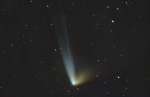 Comet Tails and Star Trails
21.07.2015
After grazing the western horizon on northern summer evenings Comet PanSTARRS (also known as C/2014 Q1) climbed higher in southern winter skies. A visitor to the inner Solar System discovered in August 2014 by the prolific panSTARRS survey, the comet was captured here on July 17.
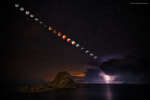 Supermoon Total Lunar Eclipse and Lightning Storm
29.09.2015
What's more rare than a supermoon total lunar eclipse? How about a supermoon total lunar eclipse over a lightning storm. Such an electrifying sequence was captured yesterday from Ibiza, an island in southeastern Spain.
 Aurora Australis and the International Space Station
13.09.2024
This snapshot from the International Space Station was taken on August 11 while orbiting about 430 kilometers above the Indian Ocean, Southern Hemisphere, planet Earth. The spectacular view looks south and east, down toward the planet's horizon and through red and green curtains of aurora australis.
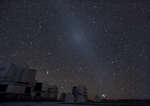 The Gegenschein Over Chile
2.12.2012
Is the night sky darkest in the direction opposite the Sun? No. In fact, a rarely discernable faint glow known as the gegenschein (German for "counter glow") can be seen 180 degrees around from the Sun in an extremely dark sky. The gegenschein is sunlight back-scattered off small interplanetary dust particles.
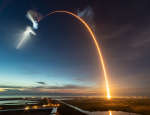 Dawn s Early Light, Rocket s Red Glare
4.07.2018
If you saw the dawn's early light from Cape Canaveral Air Force Station last Friday, June 29, then you could have seen this rocket's red glare. The single 277-second long exposure, made...
APOD: 2026 April 22 Б Earthset with an iPhone
22.04.2026
What does it mean for the Earth to set? Artemis II Commander Reid Wiseman gave us another spectacular view of Earth from their historic flyby of the Moon. Commander Wiseman's video, taken with an iPhone at 8x zoom, shows our entire planet gradually blocked from view by the Moon.
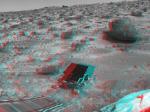 Mars: Yogi And Friends in 3D
16.07.1997
A ramp from the Pathfinder lander, the Sojourner robot rover, airbags, a couch, Barnacle Bill, and Yogi Rock appear together in this 3D stereo view of the surface of Mars. Barnacle Bill is the rock just left of the solar-paneled Sojourner and Yogi is the big friendly-looking boulder at the right.
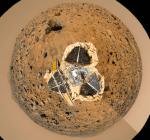 Slightly Above Mars Pathfinder
12.09.2000
If you could have hovered above the Pathfinder mission to Mars in 1997, this is what you might have seen. Directly below you is the control tower of Sagan Memorial Station. Three dark solar...
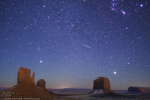 Geminid Meteor over Monument Valley
12.12.2009
The Geminids are expected to put on a good show this year. Created as planet Earth sweeps through dusty debris from extinct comet Phaethon, the annual Geminid meteor shower is predicted to peak on December 14th, around 0510 UT (12:10am EST).
|
January February March April May June July August September October |
|||||||||||||||||||||||||||||||||||||||||||||||||