
|
You entered: massive stars
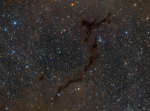 Barnard 150: Seahorse in Cepheus
25.10.2018
Light-years across, this suggestive shape known as the Seahorse Nebula appears in silhouette against a rich, luminous background of stars. Seen toward the royal northern constellation of Cepheus, the dusty, obscuring clouds are part of a Milky Way molecular cloud some 1,200 light-years distant.
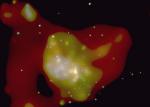 Galactic Center Flicker Indicates Black Hole
10.09.2001
Why would the center of our Galaxy flicker? Many astronomers believe the only credible answer involves a black hole. During observations of Sagittarius A* with the orbiting Chandra X-ray Observatory, the bright X-ray source at the very center of our Milky Way brightened dramatically for a few minutes.
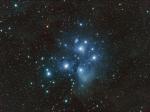 M45: The Pleiades Star Cluster
18.11.2007
Perhaps the most famous star cluster on the sky, the Pleiades can be seen without binoculars from even the depths of a light-polluted city. Also known as the Seven Sisters and M45, the Pleiades is one of the brightest and closest open clusters.
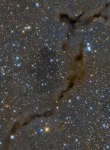 The Dark Seahorse in Cepheus
5.11.2021
Light-years across, this suggestive shape known as the Seahorse Nebula appears in silhouette against a rich, luminous background of stars. Seen toward the royal northern constellation of Cepheus, the dusty, obscuring clouds are part of a Milky Way molecular cloud some 1,200 light-years distant.
 The Dark Seahorse in Cepheus
20.04.2023
Spanning light-years, this suggestive shape known as the Seahorse Nebula appears in silhouette against a rich, luminous background of stars. Seen toward the royal northern constellation of Cepheus, the dusty, obscuring clouds are part of a Milky Way molecular cloud some 1,200 light-years distant.
 The Mystery of the Fading Star
8.01.2010
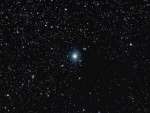
Every 27 years Epsilon Aurigae fades, remaining dim for roughly two years before growing bright again. Since the 19th century, astronomers have studied the mystery star, eventually arguing that Epsilon Aur, centered in this telescopic skyview, was actually undergoing a long eclipse by a dark companion object.
 The Pleiades Star Cluster
1.12.2002
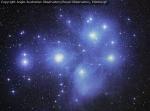
It is the most famous star cluster on the sky. The Pleiades can be seen without binoculars from even the depths of a light-polluted city. Also known as the Seven Sisters and M45, the Pleiades is one of the brightest and closest open clusters.
 NGC 5882: A Small Planetary Nebula
28.08.1996
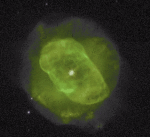
Will most stars one day look like this? Pictured above is the planetary nebula NGC 5882, captured by the Hubble Space Telescope. Although planetary nebulae can appear similar to planets like Uranus and Neptune, they are actually gas clouds surrounding stars typically hundreds of light years away.
 The Medusa Nebula
22.11.2024
Braided and serpentine filaments of glowing gas suggest this nebula's popular name, The Medusa Nebula. Also known as Abell 21, this Medusa is an old planetary nebula some 1,500 light-years away in the constellation Gemini. Like its mythological namesake, the nebula is associated with a dramatic transformation.
 M45: The Pleiades Star Cluster
9.12.2008
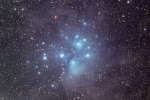
Perhaps the most famous star cluster on the sky, the Pleiades can be seen without binoculars from even the depths of a light-polluted city. Also known as the Seven Sisters and M45, the Pleiades is one of the brightest and closest open clusters.
|
January February March April |
|||||||||||||||||||||||||||||||||||||||||||||||||