
|
You entered: Solar System
 APOD: 2025 February 19 Б HH 30: A Star System with Planets Now Forming
19.02.2025
How do stars and planets form? New clues have been found in the protoplanetary system Herbig-Haro 30 by the James Webb Space Telescope in concert with Hubble and the Earth-bound ALMA. The observations show, among other things, that large dust grains are more concentrated into a central disk where they can form planets.
 APOD: 2025 April 29 Б Saturns Rings Appear to Disappear
29.04.2025
Where are Saturn's ears? Galileo is credited, in 1610, as the first person to see Saturn's rings. Testing out Lipperhey's recently co-invented telescope, Galileo did not know what they were and so called them "ears". The mystery deepened in 1612, when Saturn's ears mysteriously disappeared.
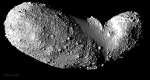 APOD: 2026 June 30 Б Unusually Smooth Sections of Asteroid Itokawa
30.06.2026
Why are parts of this asteroid's surface so smooth? The answer seems likely to do with the dynamics of an asteroid that is a loose pile of rubble rather than a solid rock.
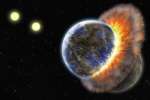 The Case of the Very Dusty Binary Star
25.09.2008
For astronomers, close binary star system BD+20 307 originally stood out because it is extremely dusty. A substantial amount of warm dust surrounding it causes the system to appear exceptionally bright at infrared wavelengths. Of course, dust associated with planet formation is often detected around young stars, stars only a few million years old.
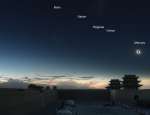 Planets, Great Wall, and Solar Eclipse
18.07.2009
This dramatic skyscape was recorded during the August 2008 total solar eclipse. The Moon's silhouette surrounded by a glistening solar corona hangs above the Jiayuguan Fort along the western edge of the Great Wall of China.
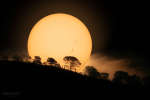 Sun Spot Hill
21.09.2021
Is this giant orange ball about to roll down that tree-lined hill? No, because the giant orange ball is actually the Sun. Our Solar System's central star was captured rising beyond a hill on Earth twelve days ago complete with a delightfully detailed foreground.
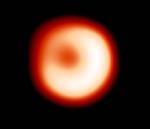 LkHa101: The Hole in the Doughnut
2.03.2001
You'd need a really big cup of coffee with this doughnut ... because the hole in the middle is about a billion kilometers across. Centered on the Sun, a circle that size would lie between the orbits of Mars and Jupiter.
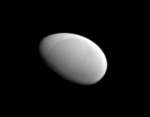 Methone: Smooth Egg Moon of Saturn
6.11.2012
Why is this moon shaped like a smooth egg? The robotic Cassini spacecraft completed the first flyby ever of Saturn's small moon Methone in May and discovered that the moon has no obvious craters.
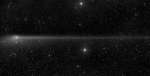 PanSTARRS Anti Tail Grows
26.05.2013
As planet Earth approached the plane of the Comet PanSTARRS (C/2011 L4) orbit on May 23rd, comet watchers were treated to this view of its magnificent anti-tail. The long, narrow anti-tail stretches to the right across this frame for nearly 4 degrees or about 8 times the angular size of the full Moon.
 Valles Marineris: The Grand Canyon of Mars
29.05.2016
Mars will look good in Earth's skies over the next few days -- but not this good. To get a view this amazing, a spacecraft had to actually visit the red planet. Running across the image center, though, is one the largest canyons in the Solar System.
|
January February March April May June July August |
||||||||||||||||||||||||||||||||||||||||||||||||||||||||