
|
You entered: massive stars
 APOD: 2025 October 7 Б SN Encore: A Second Supernova Seen Several Times
7.10.2025
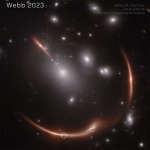
Now a second supernova in this same galaxy is repeating. The cause is the gravitational lens effect of a massive foreground cluster of galaxies (MACS J0138) -- it creates multiple images of a perfectly aligned background galaxy (MRG-M0138). What's particularly interesting is that this background galaxy has young stars that keep blowing up.
 Stripping ESO 137 001
28.03.2014
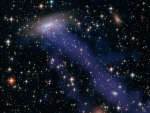
Spiral galaxy ESO 137-001 hurtles through massive galaxy cluster Abell 3627 some 220 million light years away. The distant galaxy is seen in this colorful Hubble/Chandra composite image through a foreground of the Milky Way's stars toward the southern constellation Triangulum Australe.
 Stripping ESO 137-001
1.08.2015
Spiral galaxy ESO 137-001 hurtles through massive galaxy cluster Abell 3627 some 220 million light years away. The distant galaxy is seen in this colorful Hubble/Chandra composite image through a foreground of the Milky Way's stars toward the southern constellation Triangulum Australe.
 Stripping ESO 137-001
25.08.2018
Spiral galaxy ESO 137-001 hurtles through massive galaxy cluster Abell 3627 some 220 million light years away. The distant galaxy is seen in this colorful Hubble/Chandra composite image through a foreground of the Milky Way's stars toward the southern constellation Triangulum Australe.
 Ring Around Fomalhaut
1.07.2005
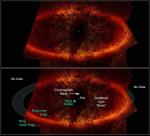
Fomalhaut (sounds like "foam-a-lot") is a bright, young, star, a mere 25 light-year trip from planet Earth in the direction of the constellation Piscis Austrinus. Earlier infrared observations identified a torus of cold material...
 Microlensing of the Einstein Cross
11.07.1995
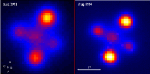
The famous "Einstein Cross" is a case where a single object is seen four times. Here a very distant QSO happened to be placed right behind a massive galaxy. The gravitational effect...
 Abell 1795: A Galaxy Cluster s Cooling Flow
8.12.2000
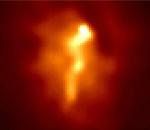
Throughout the Universe, galaxies tend to swarm in groups ranging from just a handful of members to casts of thousands. Astronomers have realized since the early 1970s that the larger swarms, immense clusters of galaxies millions of light-years across, are immersed within tenuous clouds of hot gas which glow strongly in x-rays.
 Microlensing of the Einstein Cross
15.12.1996
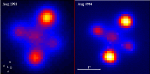
The famous "Einstein Cross" is a case where a single object is seen four times. Here a very distant QSO happened to be placed right behind a massive galaxy. The gravitational effect...
 Palomar at Night
7.08.2003
What's wrong with this picture? The summer night sky is clear, and moonlight illuminates the dome of the Hale 200-inch Telescope at Palomar Observatory, northeast of San Diego, California, USA. The familiar stars of the Teapot asterism in the constellation Sagittarius shine above the dome and to the right.
 Two Black Holes Merge
12.02.2016
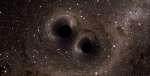
Just press play to watch two black holes merge. Inspired by the first direct detection of gravitational waves by LIGO, this simulation video plays in slow motion but would take about one third of a second if run in real time.
|
January February March April |
|||||||||||||||||||||||||||||||||||||||||||||||||