
|
You entered: Earth orbit
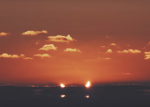 APOD: 2025 April 1 Б A Double Sunrise from a Partial Eclipse
1.04.2025
Can the Sun appear to rise twice at the same time? This was just the case a few days ago from Les Escoumins, Quebec, Canada as our Solar System's bright central orb rose just as it was being partially eclipsed by the Moon.
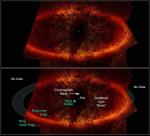 Ring Around Fomalhaut
1.07.2005
Fomalhaut (sounds like "foam-a-lot") is a bright, young, star, a mere 25 light-year trip from planet Earth in the direction of the constellation Piscis Austrinus. Earlier infrared observations identified a torus of cold material...
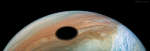 Io Eclipse Shadow on Jupiter from Juno
7.10.2019
What's that dark spot on Jupiter? It's the shadow of Jupiter's most volcanic moon Io. Since Jupiter shines predominantly by reflected sunlight, anything that blocks that light leaves a shadow. If you could somehow be in that shadow, you would see a total eclipse of the Sun by Io.
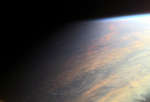 Planet Earth at Twilight
22.04.2021
No sudden, sharp boundary marks the passage of day into night in this gorgeous view of ocean and clouds over our fair planet Earth. Instead, the shadow line or terminator is diffuse and shows the gradual transition to darkness we experience as twilight.
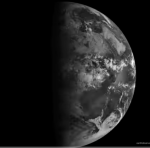 Equinox on Planet Earth
20.03.2019
Welcome to an equinox on planet Earth. Today is the first day of spring in our fair planet's northern hemisphere, fall in the southern hemisphere, with day and night nearly equal around the globe.
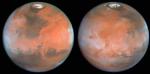 Bound For Mars
22.05.1997
Two NASA spacecraft, Mars Global Surveyor and Mars Pathfinder, are presently approaching the red planet. Pathfinder is scheduled to land on July 4th and Global Surveyor due to enter orbit in September. Recent studies...
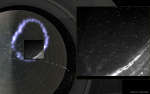 Aurorae and Lightning on Jupiter
24.03.2021
Why does so much of Jupiter's lightning occur near its poles? Similar to Earth, Jupiter experiences both aurorae and lightning. Different from Earth, though, Jupiter's lightning usually occurs near its poles -- while much of Earth's lightning occurs near its equator.
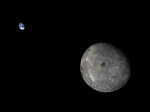 Moon and Earth from Chang e 5 T1
3.11.2014
Described at times as a big blue marble, from some vantage points Earth looks more like a small blue marble. Such was the case in this iconic image of the Earth and Moon system taken by the Chang'e 5-T1 mission last week.
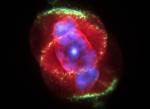 X-rays From The Cat's Eye
11.01.2001
Haunting patterns within planetary nebula NGC 6543 readily suggest its popular moniker -- the Cat's Eye nebula. In 1995, a stunning false-color optical image from the Hubble Space Telescope detailed the swirls of this glowing nebula, known to be the gaseous shroud expelled from a dying sun-like star about 3,000 light-years from Earth.
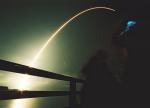 Messenger Launch
14.08.2004
Streaking into the early morning sky on August 3rd, a Delta II rocket launches NASA's Messenger spacecraft on an interplanetary voyage to Mercury. Scheduled to become the first probe to orbit Mercury, Messenger will begin by looping through the inner Solar System in a series of close flybys of planet Earth and Venus.
|
January February March April May June July August September October |
|||||||||||||||||||||||||||||||||||||||||||||||||