
|
You entered: atmosphere
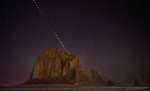 APOD: 2026 March 5 Б Total Lunar Eclipse over Tse Bitai
5.03.2026
Earlier this week, EarthБs shadow swept across the full Moon in the yearБs only total lunar eclipse. This stunning sequence combines images showing the MoonБs path across the night sky. Each lunar image captures our planetБs shadow gradually engulfing the Moon, culminating in its red glow.
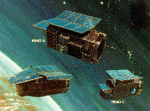 A High Energy Fleet
25.05.1997
Looking like a fleet of futuristic starcruisers, NASA's highly successful series of High Energy Astrophysical Observatory (HEAO) spacecraft appear poised over planet Earth. Labeled A, B, and C in this vintage illustration, the spacebased telescopes were known as HEAO-1, HEAO-2, and HEAO-3 respectively.
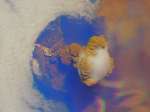 Sarychev Peak Volcano in Stereo
25.06.2009
From 400 kilometers above planet Earth, the Expedition 20 Crew onboard the International Space Station (ISS) was able to witness a remarkable event from a remarkable vantage point -- the June 12 eruption of the Sarychev Peak Volcano. The active volcano is located in Russia's Kuril Island chain, stretching to the northeast of Japan.
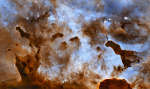 Dark Clouds of the Carina Nebula
19.09.2010
What dark forms lurk in the mists of the Carina Nebula? These ominous figures are actually molecular clouds, knots of molecular gas and dust so thick they have become opaque. In comparison, however, these clouds are typically much less dense than Earth's atmosphere.
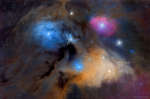 The Colorful Clouds of Rho Ophiuchi
14.10.2020
The many spectacular colors of the Rho Ophiuchi (oh'-fee-yu-kee) clouds highlight the many processes that occur there. The blue regions shine primarily by reflected light. Blue light from the Rho Ophiuchi star system and nearby stars reflects more efficiently off this portion of the nebula than red light.
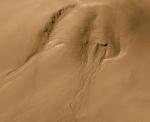 The Gullies Of Mars
23.06.2000
The recently revealed gullies on Mars are rare. But they may prove to be sites of present day, near surface, liquid water, holding out the tantalizing possibility of martian life. Too small to have...
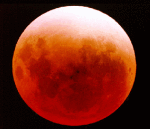 A Lucky Lunar Eclipse
3.04.1996
Tonight's full moon would normally washout the spectacle of Comet Hyakutake's lovely tail, even for those far from light polluted skies. Except that tonight comet observers are in luck - the dance of the planets calls for a total lunar eclipse! Lunar eclipses are caused when the Moon passes through the Earth's shadow.
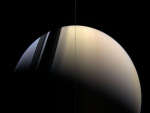 Saturn in Blue and Gold
13.04.2014
Why is Saturn partly blue? The above picture of Saturn approximates what a human would see if hovering close to the giant ringed world. The above picture was taken in 2006 March by the robot Cassini spacecraft now orbiting Saturn. Here Saturn's majestic rings appear directly only as a thin vertical line.
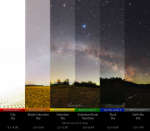 Country Sky versus City Sky
8.04.2020
Dark skies are disappearing from the world. With modernization comes artificial lighting that brightens the night. While these lights allow modern humans to see, much light is wasted up into the sky. This light...
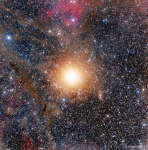 Behind Betelgeuse
11.05.2020
What's behind Betelgeuse? One of the brighter and more unusual stars in the sky, the red supergiant star Betelgeuse can be found in the direction of famous constellation Orion. Betelgeuse, however, is actually...
|
January February March April May June July August September October |
|||||||||||||||||||||||||||||||||||||||||||||||||