
|
You entered: clouds
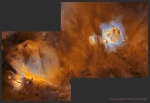 Horsehead and Orion Nebulas
18.03.2019
The dark Horsehead Nebula and the glowing Orion Nebula are contrasting cosmic vistas. Adrift 1,500 light-years away in one of the night sky's most recognizable constellations, they appear in opposite corners of the above stunning two-panel mosaic.
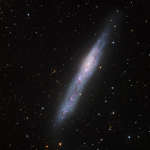 Magellanic Galaxy NGC 55
12.07.2019
Irregular galaxy NGC 55 is thought to be similar to the Large Magellanic Cloud (LMC). But while the LMC is about 180,000 light-years away and a well-known satellite of our own Milky Way Galaxy, NGC 55 is more like 6 million light-years distant, a member of the Sculptor Galaxy Group.
 Galaxy Wars: M81 and M82
15.05.2020
These two galaxies are far far away, 12 million light-years distant toward the northern constellation of the Great Bear. On the left, with grand spiral arms and bright yellow core is spiral galaxy M81, some 100,000 light-years across. On the right marked by red gas and dust clouds, is irregular galaxy M82.
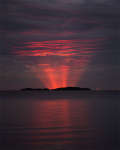 Red Crepuscular Rays from an Eclipse
30.05.2022
What's happening behind that island? Things both expected and unexpected. Expected, perhaps, the pictured rays of light -- called crepuscular rays -- originate from the Sun. Unexpected, though, the Sun was being partially eclipsed by the Moon at the time -- late last month.
 APOD: 2026 January 26 Б NGC 55: A Galaxy of Nebulas
26.01.2026
Can you see nebulas in other galaxies? Yes, some nebulas shine brightly enough -- if you know how to look. Clouds of hydrogen and oxygen emit light at very specific colors, and by isolating them, astronomers and astrophotographers can reveal structures that would otherwise be too faint to notice.
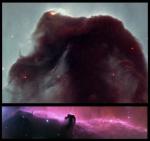 Horsehead Rides Again
26.04.2001
Difficult to see in small telescopes, the Horsehead nebula was recently selected by internet voters as a target for the Hubble Space Telescope. Above (top) is Hubble's detailed view of the dark cosmic dust cloud, released to celebrate the 11th anniversary of the workhorse orbiting observatory.
 Vista with NGC 2170
15.10.2010
Drifting through the one-horned constellation Monoceros, these dusty streamers and new born stars are part of the active Monoceros R2 star-forming region, embedded in a giant molecular cloud. The cosmic scene was recorded by the VISTA survey telescope in near-infrared light.
 Aurora over Maine
17.09.2014
It has been a good week for auroras. Earlier this month active sunspot region 2158 rotated into view and unleashed a series of flares and plasma ejections into the Solar System during its journey across the Sun's disk.
 Titan Seas Reflect Sunlight
1.02.2015
Why would the surface of Titan light up with a blinding flash? The reason: a sunglint from liquid seas. Saturn's moon Titan has numerous smooth lakes of methane that, when the angle is right, reflect sunlight as if they were mirrors.
 Reflections on VdB 31
13.02.2025
Riding high in the constellation of Auriga, beautiful, blue VdB 31 is the 31st object in Sidney van den Bergh's 1966 catalog of reflection nebulae. It shares this well-composed celestial still life with dark, obscuring clouds B26, B27, and B28, recorded in Edward E. Barnard's 1919 catalog of dark markings in the sky.
|
January February March April May June July August September October |
|||||||||||||||||||||||||||||||||||||||||||||||||