
|
You entered: star cluster
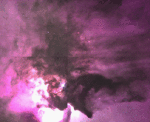 A Close-Up of the Lagoon Nebula
20.08.1996
Ribbons of red-glowing gas and dark dust surround massive young stars in this close-up of the Lagoon Nebula taken by the Hubble Space Telescope. The Lagoon Nebula is relatively close and bright - it appears larger than the Full Moon and is visible even without a telescope.
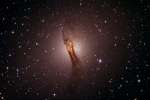 Centaurus A
12.03.2010
Only 11 million light-years away, Centaurus A is the closest active galaxy to planet Earth. Spanning over 60,000 light-years, the peculiar elliptical galaxy, also known as NGC 5128, is featured in this sharp color image.
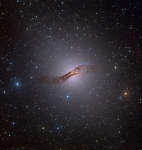 Centaurus A
16.03.2022
A mere 11 million light-years away, Centaurus A is the closest active galaxy to planet Earth. Spanning over 60,000 light-years, the peculiar elliptical galaxy also known as NGC 5128, is featured in this sharp telescopic view.
 Little Planet Aurora
24.11.2023
Immersed in an eerie greenish light, this rugged little planet appears to be home to stunning water falls and an impossibly tall mountain. It's planet Earth of course. On the night of November 9 the nadir-centered 360 degree mosaic was captured by digital camera from the Kirkjufell mountain area of western Iceland.
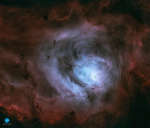 The Lagoon Nebula without Stars
7.08.2022
Ridges of glowing interstellar gas and dark dust clouds inhabit the turbulent, cosmic depths of the Lagoon Nebula. Also known as M8, the bright star forming region is about 5,000 light-years distant.
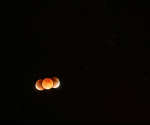 Earthshadow and the Beehive
2.02.2018
The Earth's dark umbral shadow is shaped like a cone extending into space. Of course its circular cross section at the distance of the Moon is more easily seen during a lunar eclipse.
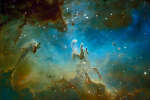 The Pillars of Eagle Castle
10.07.2009
What lights up this castle of star formation? The familiar Eagle Nebula glows bright in many colors at once. The above image is a composite of three of these glowing gas colors. Pillars of dark dust nicely outline some of the denser towers of star formation.
 APOD: 2023 April 10 Б IC 2944: The Running Chicken Nebula
9.04.2023
To some, it looks like a giant chicken running across the sky. To others, it looks like a gaseous nebula where star formation takes place. Cataloged as IC 2944, the Running Chicken Nebula spans about 100 light years and lies about 6,000 light years away toward the constellation of the Centaur (Centaurus).
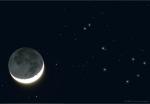 April s Moon and the Pleiades
14.04.2005
After parting with the Sun late last week, April's moon graced the early evening sky. Its slender, three-day-old crescent shares this lovely telescopic skyview with the nearby Pleiades star cluster. Here, the Moon...
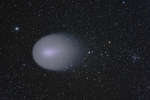 Comet Holmes Over Hungary
4.12.2007
Comet Holmes refuses to fade. The unusual comet that surprisingly brightened nearly a million-fold in late October continues to remain visible to the unaided eye from dark locations. Night to night, Comet 17P/Holmes is slowly gliding through the constellation Perseus, remaining visible to northern observers during much of the night right from sunset.
|
January February March April May June July August September October |
|||||||||||||||||||||||||||||||||||||||||||||||||