
|
You entered: stars
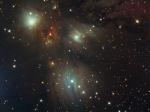 Still Life with NGC 2170
3.03.2005
In this beautiful celestial still life composed with a cosmic brush, dusty nebula NGC 2170 shines at the upper left. Reflecting the light of nearby hot stars, NGC 2170 is joined by other bluish reflection nebulae and a compact red emission region against a backdrop of stars.
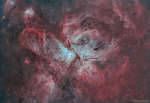 The Great Nebula in Carina
7.05.2019
What's happening in the center of the Carina Nebula? Stars are forming, dying, and leaving an impressive tapestry of dark dusty filaments. The entire Carina Nebula, cataloged as NGC 3372, spans over 300 light years and lies about 8,500 light-years away in the constellation of Carina.
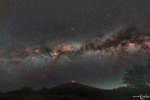 Mount Etna Milky Way
5.07.2024
A glow from the summit of Mount Etna, famous active stratovolcano of planet Earth, stands out along the horizon in this mountain and night skyscape. Bands of diffuse light from congeries of innumerable stars along the Milky Way galaxy stretch across the sky above.
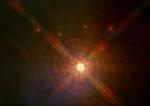 Young Suns
19.02.2000
The star cataloged as NGC2264 IRS is normally hidden from the inquiring gaze of optical telescopes. It resides in the midst of the obscuring gas and dust of a nearby star forming region popularly known as the Cone Nebula.
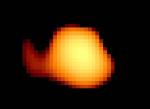 Resolving Mira
21.01.2001
Most stars appear only as points of light. In 1995, Betelgeuse became the second star, after our Sun, to have it surface resolved. Later that year, Mira was added to the list. Mira...
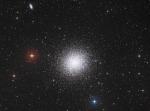 M13: The Great Globular Cluster in Hercules
15.11.2007
M13 is modestly recognized as the Great Globular Cluster in Hercules. A system of stars numbering in the hundreds of thousands, it is one of the brightest globular star clusters in the northern sky.
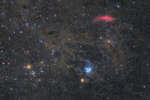 Mars in Taurus
4.03.2021
You can spot Mars in the evening sky tonight. Now home to the Perseverance rover, the Red Planet is presently wandering through the constellation Taurus, close on the sky to the Seven Sisters or Pleiades star cluster.
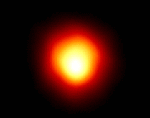 Betelgeuse, Betelgeuse, Betelgeuse
22.01.1996
Betelgeuse (sounds a lot like "beetle juice"), a red supergiant star about 600 lightyears distant, is shown here in this Hubble Space Telescope image which represents the first direct picture of the surface of a star other than the Sun.
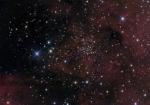 Tombaugh 4
21.10.2006
Clyde Tombaugh discovered planet Pluto in 1930 while surveying the skies with the 13-inch Lawrence Lowell Telescope. But the skilled and careful astronomer also went on to discover star clusters, comets, asteroids, and clusters of galaxies. For example, pictured is galactic or open star cluster Tombaugh 4 in the northern constellation Cassiopeia.
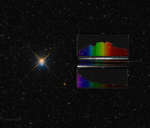 Beautiful Albireo AB
24.02.2022
Beta Cygni is a single bright star to the naked eye. About 420 light-years away it marks the foot of the Northern Cross, famous asterism in the constellation Cygnus. But a view through...
|
January February March April May June July August September October |
|||||||||||||||||||||||||||||||||||||||||||||||||