
|
You entered: young stars
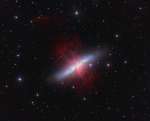 M82: Starburst Galaxy with a Superwind
4.07.2013
Also known as the Cigar Galaxy for its elongated visual appearance, M82 is a starburst galaxy with a superwind. In fact, through ensuing supernova explosions and powerful winds from massive stars, the burst of star formation in M82 is driving a prodigious outflow of material.
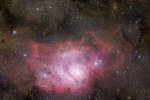 The Lagoon Nebula from GigaGalaxy Zoom
6.10.2009
The large majestic Lagoon Nebula is home for many young stars and hot gas. Spanning 100 light years across while lying only about 5000 light years distant, the Lagoon Nebulae is so big and bright that it can be seen without a telescope toward the constellation of Sagittarius.
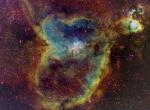 IC 1805: Light from the Heart
17.09.2004
Sprawling across hundreds of light-years, emission nebula IC 1805 is a mix of glowing interstellar gas and dark dust clouds. Only about 7,500 light-years away, stars were born in this region whose nickname - the Heart Nebula - derives from its suggestive shape (seen here sideways).
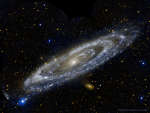 The Andromeda Galaxy in Ultraviolet
18.07.2021
What does the Andromeda galaxy look like in ultraviolet light? Young blue stars circling the galactic center dominate. A mere 2.5 million light-years away, the Andromeda Galaxy, also known as M31, really is just next door as large galaxies go.
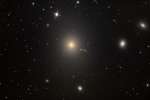 M87: Elliptical Galaxy with Jet
20.05.2010
In spiral galaxies, majestic winding arms of young stars, gas, and dust rotate in a flat disk around a bulging galactic nucleus. But elliptical galaxies seem to be simpler. Lacking gas and dust to form new stars, their randomly swarming older stars, give them an ellipsoidal (egg-like) shape. Still, elliptical galaxies can be very large.
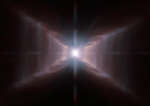 The Red Rectangle Nebula from Hubble
14.06.2010
How was the unusual Red Rectangle nebula created? At the nebula's center is a young binary star system that surely powers the nebula but does not, as yet, explain its colors. The unusual...
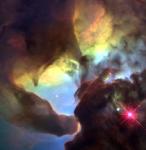 Twistin' by the Lagoon
23.01.1997
The awesome spectacle of starbirth produces extreme stellar winds and intense energetic starlight -- bombarding dusty molecular clouds inside the Lagoon Nebula (M8). At least two long funnel shaped clouds, each roughly half a light-year long, have apparently been formed by this activity.
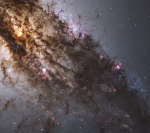 Across the Center of Centaurus A
29.11.2011
A fantastic jumble of young blue star clusters, gigantic glowing gas clouds, and imposing dark dust lanes surrounds the central region of the active galaxy Centaurus A. This image from the Hubble Space Telescope has been processed to present a natural color picture of this cosmic maelstrom.
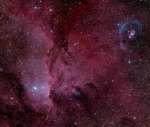 NGC 6188 and NGC 6164
28.07.2011
Fantastic shapes lurk in clouds of glowing hydrogen gas in NGC 6188. The emission nebula is found near the edge of a large molecular cloud, unseen at visible wavelengths, in the southern constellation Ara, about 4,000 light-years away.
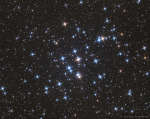 M44: The Beehive Cluster
30.04.2022
A mere 600 light-years away, M44 is one of the closest star clusters to our solar system. Also known as the Praesepe or the Beehive cluster its stars are young though, about 600 million years old compared to our Sun's 4.5 billion years.
|
January February March April May June July August September October |
|||||||||||||||||||||||||||||||||||||||||||||||||