
|
You entered: light
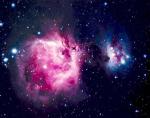 The Great Nebula in Orion
27.01.1998
The Great Nebula in Orion can be found just below and to the left of the easily identifiable belt of three stars in the popular constellation Orion. This fuzzy patch contains one of the closest stellar nurseries, lying at a distance of about 1500 light years.
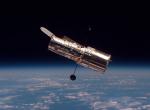 Hubble Floats Free
24.11.2002
Why put observatories in space? Most telescopes are on the ground. On the ground, you can deploy a heavier telescope and fix it more easily. The trouble is that Earth-bound telescopes must look through the Earth's atmosphere.
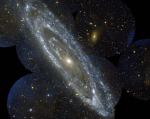 The Andromeda Galaxy from GALEX
22.12.2003
Why does the Andromeda Galaxy have a giant ring? Viewed in ultraviolet light, the closet major galaxy to our Milky Way Galaxy looks more like a ring galaxy than a spiral. The ring...
 The 220 Mirrors of CRTF
4.10.1999
Even the largest of modern optical telescopes are small when compared with the light gathering power of the Central Receiver Test Facility (CRTF) located in New Mexico, USA. CRTF has 220 mirrors each over 7-meters in diameter all focused on a single tower.
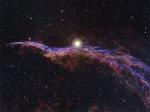 NGC 6960: The Witch's Broom Nebula
1.01.2007
Ten thousand years ago, before the dawn of recorded human history, a new light must suddenly have appeared in the night sky and faded after a few weeks. Today we know this light was an exploding star and record the colorful expanding cloud as the Veil Nebula.
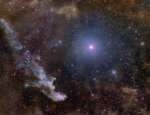 Rigel and the Witch Head Nebula
1.11.2012
Double, double toil and trouble; Fire burn, and cauldron bubble -- maybe Macbeth should have consulted the Witch Head Nebula. The suggestively shaped reflection nebula is associated with the bright star Rigel in the constellation Orion.
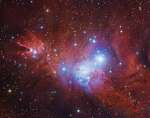 In the Vicinity of the Cone Nebula
6.08.2013
Strange shapes and textures can be found in neighborhood of the Cone Nebula. The unusual shapes originate from fine interstellar dust reacting in complex ways with the energetic light and hot gas being expelled by the young stars.
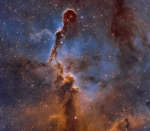 The Elephant s Trunk Nebula in Cepheus
16.08.2019
Like an illustration in a galactic Just So Story, the Elephant's Trunk Nebula winds through the emission nebula and young star cluster complex IC 1396, in the high and far off constellation of Cepheus. Also known as vdB 142, the cosmic elephant's trunk is over 20 light-years long.
 NGC 2442: Galaxy in Volans
1.04.2023
Distorted galaxy NGC 2442 can be found in the southern constellation of the flying fish, (Piscis) Volans. Located about 50 million light-years away, the galaxy's two spiral arms extending from a pronounced central...
 Reflections on VdB 31
13.02.2025
Riding high in the constellation of Auriga, beautiful, blue VdB 31 is the 31st object in Sidney van den Bergh's 1966 catalog of reflection nebulae. It shares this well-composed celestial still life with dark, obscuring clouds B26, B27, and B28, recorded in Edward E. Barnard's 1919 catalog of dark markings in the sky.
|
January February March April May June July August September October |
|||||||||||||||||||||||||||||||||||||||||||||||||