
|
You entered: planets
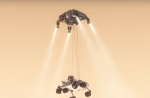 Landing on Mars: Seven Minutes of Terror
15.02.2021
Starting Thursday, there may be an amazing new robotic explorer on Mars. Or there may be a new pile of junk. It all likely depends on things going correctly in the minutes after the Mars 2020 mission arrives at its new home planet and attempts to deploy the Perseverance rover.
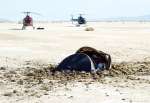 APOD: 2026 July 19 Б Flying Saucer Crash Lands in Utah Desert
19.07.2026
A flying saucer from outer space crash-landed in the Utah desert after being tracked by radar and chased by helicopters. The year was 2004, and no space aliens were involved. The saucer, pictured here...
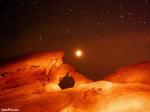 Mars to Appear Normal this August
8.08.2005
Will Mars appear extremely close and bright later this month? No. Regardless of numerous urban legends circulating, Mars will a relatively normal August. October is the best month to see Mars this year. The red planet is now visible in the morning before sunrise.
 Earths Shrinking Antarctic Ice Sheet
8.03.2006
Is the continent at the end of the Earth slowly melting? For millions of years, Antarctica, the frozen continent at the southern end of planet Earth, has been encased in a gigantic sheet of ice. Recently, the orbiting robotic GRACE satellite has been taking sensitive measurements of the gravity for the entire Earth, including Antarctica.
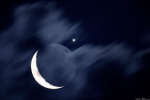 Moon Meets Jupiter
10.07.2016
What's that next to the Moon? Jupiter -- and its four largest moons. Skygazers around planet Earth enjoyed the close encounter of planets and Moon in 2012 July 15's predawn skies. And while...
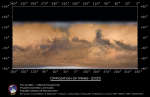 Global Map: Mars at Opposition
20.11.2020
This may be the best global Mars map made with a telescope based on planet Earth. The image data were captured by a team of observers over six long nights...
 Welcome to Perihelion
4.01.2025
Earth's orbit around the Sun is not a circle, it's an ellipse. The point along its elliptical orbit where our fair planet is closest to the Sun is called perihelion. This year perihelion is today, January 4, at 13:28 UTC, with the Earth about 147 million kilometers from the Sun.
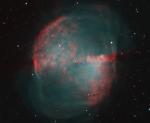 M27: Not A Comet
3.08.2006
While searching the skies above 18th century France for comets, astronomer Charles Messier diligently recorded this object as number 27 on his list of things which are definitely not comets. So what is it?
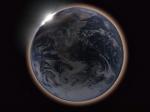 Solar Eclipse from the Moon
2.03.2007
Parts of Saturday's (March 3) lunar eclipse will be widely visible. For example, skywatchers in Europe, Africa, and western Asia will be able to see the entire spectacle of the Moon gliding through Earth's shadow, but in eastern North America the Moon will rise already in its total eclipse phase.
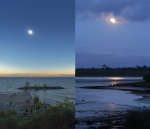 August Moons
21.08.2008
This August was eclipse season. The month's first New Moon and Full Moon were both seen in darkened skies during a solar and lunar eclipse. Blocking the Sun, the left panel...
|
January February March April May June July August September October |
|||||||||||||||||||||||||||||||||||||||||||||||||