
|
You entered: Milky Way
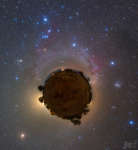 A Little Like Mars
5.03.2021
The surface of this planet looks a little like Mars. It's really planet Earth though. In a digitally stitched little planet projection, the 360 degree mosaic was captured near San Pedro in the Chilean Atacama desert. Telescopes in domes on the horizon are taking advantage of the region's famously dark, clear nights.
 APOD: 2025 December 3 Б Visualization: Near a Black Hole and Disk
3.12.2025
What would it look like to plunge into a monster black hole? This image from a supercomputer visualization shows the entire sky as seen from a simulated camera plunging toward a 4-million-solar-mass black hole, similar to the one at the center of our galaxy.
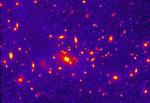 A Massive Cluster In A Young Universe
21.08.1998
Conventional theories suggest that this cluster of galaxies should not exist. Each fuzzy spot in this false-color Hubble Space Telescope image of the central regions of a newly discovered galaxy cluster is a galaxy similar in mass to our own Milky Way.
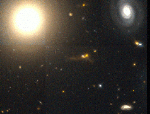 Elliptical Galaxy NGC 4881 in Coma
6.11.1996
Elliptical galaxies are unlike spiral galaxies and hence unlike our own Milky Way Galaxy. The giant elliptical galaxy named NGC 4881 on the upper left lies at the edge of the giant Coma Cluster of Galaxies.
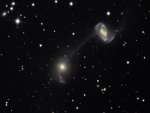 Galaxies on a String
31.07.2008
Galaxies NGC 5216 (top right) and NGC 5218 really do look like they are connected by a string. Of course, that string is a cosmic trail of gas, dust, and stars about 22,000 light-years long.
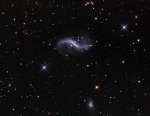 Virgo Cluster Galaxy NGC 4731
29.04.2010
Barred spiral galaxy NGC 4731 lies some 65 million light-years away. The lovely island universe resides in the large Virgo cluster of galaxies. Colors in this well-composed, cosmic portrait, highlight plentiful, young, bluish star clusters along the galaxy's sweeping spiral arms.
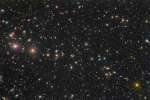 The Perseus Cluster of Galaxies
12.07.2011
Here is one of the largest objects that anyone will ever see on the sky. Each of these fuzzy blobs is a galaxy, together making up the Perseus Cluster, one of the closest clusters of galaxies. The cluster is seen through a foreground of faint stars in our own Milky Way Galaxy.
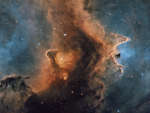 IC 1871: Inside the Soul Nebula
29.10.2015
This cosmic close-up looks deep inside the Soul Nebula. The dark and brooding dust clouds outlined by bright ridges of glowing gas are cataloged as IC 1871. About 25 light-years across, the telescopic field of view spans only a small part of the much larger Heart and Soul nebulae.
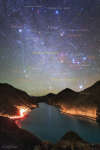 Winter Hexagon over Manla Reservoir
23.01.2017
If you can find Orion, you might be able to find the Winter Hexagon. The Winter Hexagon involves some of the brightest stars visible, together forming a large and easily found pattern in the winter sky of Earth's northern hemisphere.
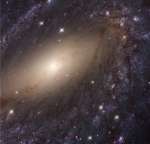 NGC 6744 Close Up
31.05.2018
Beautiful spiral galaxy NGC 6744 is nearly 175,000 light-years across, larger than our own Milky Way. It lies some 30 million light-years distant in the southern constellation Pavo, its galactic disk tilted towards our line of sight.
|
January February March April May June July August September October |
|||||||||||||||||||||||||||||||||||||||||||||||||