
|
You entered: dust cloud
 APOD: 2024 November 17 Б LDN 1471: A Windblown Star Cavity
17.11.2024
What is the cause of this unusual parabolic structure? This illuminated cavity, known as LDN 1471, was created by a newly forming star, seen as the bright source at the peak of the parabola.
 Reflections on the 1970s
2.10.2003
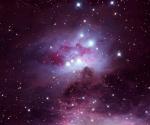
The 1970s are often overlooked. In particular, the beautiful grouping of reflection nebulae NGC 1977, NGC 1975, and NGC 1973 in Orion are often overlooked in favor of the substantial stellar nursery better known as the Orion Nebula.
 Halley Dust and Milky Way
9.05.2014
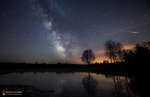
The early morning hours of May 6 were moonless when grains of cosmic dust streaked through dark skies. Swept up as planet Earth plows through dusty debris streams left behind periodic Comet Halley, the annual meteor shower is known as the Eta Aquarids.
 Comet NEOWISE Rising over the Adriatic Sea
26.07.2022
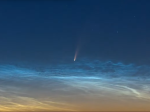
This sight was worth getting out of bed early. Two years ago this month, Comet C/2020 F3 (NEOWISE) rose before dawn to the delight of northern sky enthusiasts awake that early. Up before sunrise...
 Comet NEOWISE Rising over the Adriatic Sea
13.07.2020
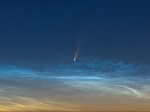
This sight was worth getting out of bed early. Comet C/2020 F3 (NEOWISE) has been rising before dawn during the past week to the delight of northern sky enthusiasts awake that early. Up before...
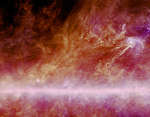 The Nearby Milky Way in Cold Dust
22.03.2010
What shapes the remarkable dust tapestry of the nearby Milky Way Galaxy? No one knows for sure. The intricate structures, shown above, were resolved in new detail recently in a wide region of the sky imaged in far infrared light by the European Space Agency's Planck satellite.
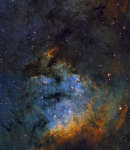 NGC 7822 in Cepheus
22.10.2010
Pillars of gas, dust, and young, hot stars seem to fill the gaping maw of NGC 7822. At the edge of a giant molecular cloud toward the northern constellation Cepheus, the glowing star forming region lies about 3,000 light-years away. Within the nebula, bright edges and dark shapes are highlighted in this colorful skyscape.
 Orion and the Running Man
13.11.2025
Few cosmic vistas can excite the imagination like The Great Nebula in Orion. Visible as a faint, bland celestial smudge to the naked-eye, the nearest large star-forming region sprawls across this sharp colorful telescopic image. Designated M42 in the Messier Catalog, the Orion Nebula's glowing gas and dust surrounds hot, young stars.
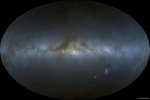 All Sky Milky Way Panorama
25.11.2009
If you could go far away from the Earth and look around the entire sky -- what would you see? Such was the goal of the All-Sky Milky Way Panorama 2.0 project of Axel Mellinger.
 Comet Tsuchinshan ATLAS Flys Away
19.10.2024
These six panels follow daily apparitions of comet C/2023 A3 Tsuchinshan-ATLAS as it moved away from our fair planet during the past week. The images were taken with the same camera and lens at the indicated dates and locations from California, planet Earth.
|
January February March April May June July August September |
|||||||||||||||||||||||||||||||||||||||||||||||||