
|
You entered: star cluster
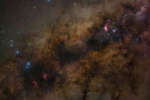 Sagittarius and the Central Milky Way
19.05.2009
What does the center of our Milky Way Galaxy look like? In visible light, no one knows! It is not possible to see the Galactic center in light our eyes are sensitive to because the thick dust in the plane of our Galaxy obscures it.
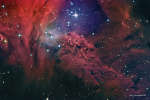 The Fox Fur Nebula
30.12.2015
This interstellar canine is formed of cosmic dust and gas interacting with the energetic light and winds from hot young stars. The shape, visual texture, and color, combine to give the region the popular name Fox Fur Nebula.
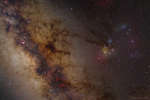 A Wide Field Image of the Galactic Center
6.01.2012
From Sagittarius to Scorpius, the central Milky Way is a truly beautiful part of planet Earth's night sky. The gorgeous region is captured in this wide field image spanning about 30 degrees.
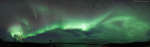 Northern Lights over Prelude Lake
17.09.2010
Curtains of shimmering green light sprawl across this gorgeous night skyscape. In the foreground lies the peaceful Prelude Lake, located about 30 kilometers east of Yellowknife, Northwest Territories, Canada. From high northern latitudes these mesmerizing northern lights, also known as the aurora borealis, are becoming a more familiar sight.
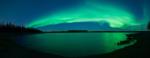 Aurora, Stars, Meteor, Lake, Alaska
9.10.2007
Sometimes, after your eyes adapt to the dark, a spectacular sky appears. In this case, a picturesque lake lies in front of you, beautiful green aurora flap high above you, brilliant stars shine far in the distance, and, for a brief moment, a bright meteor streaks by.
 APOD: 2023 July 10 Б Stars, Dust and Nebula in NGC 6559
10.07.2023
When stars form, pandemonium reigns. A textbook case is the star forming region NGC 6559. Visible in the featured image are red glowing emission nebulas of hydrogen, blue reflection nebulas of dust, dark absorption nebulas of dust, and the stars that formed from them.
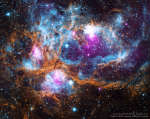 NGC 6357: Stellar Wonderland
26.12.2016
For reasons unknown, NGC 6357 is forming some of the most massive stars ever discovered. This complex wonderland of star formation consists of numerous filaments of dust and gas surrounding huge cavities of massive star clusters. The intricate patterns are caused by complex interactions between interstellar winds, radiation pressures, magnetic fields, and gravity.
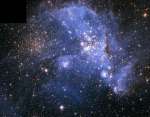 NGC 346 in the Small Magellanic Cloud
17.10.2010
How and why are all these stars forming? Found among the Small Magellanic Cloud's (SMC's) clusters and nebulae NGC 346 is a star forming region about 200 light-years across, pictured above by the Hubble Space Telescope.
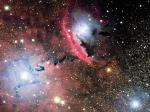 Stars, Dust and Nebula in NGC 6559
9.05.2005
When stars form, pandemonium reigns. A textbook case is the star forming region NGC 6559. Visible above are red glowing emission nebulas of hydrogen, blue reflection nebulas of dust, dark absorption nebulas of dust, and the stars that formed from them.
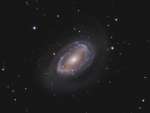 One Armed Spiral Galaxy NGC 4725
6.06.2009
While most spiral galaxies, including our own Milky Way, have two or more spiral arms, NGC 4725 seems to have only one. In this sharp color image, the solo spira mirabilis is tightly wound, traced by bluish, newborn star clusters.
|
January February March April May June July August September October |
|||||||||||||||||||||||||||||||||||||||||||||||||