
|
You entered: wind
 APOD: 2024 July 23 Б The Crab Nebula from Visible to X Ray
23.07.2024
What powers the Crab Nebula? A city-sized magnetized neutron star spinning around 30 times a second. Known as the Crab Pulsar, it is the bright spot in the center of the gaseous swirl at the nebula's core.
 Sungrazer
26.02.1997
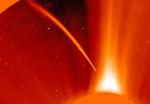
Arcing toward a fiery fate, this Sungrazer comet was recorded by the SOHO spacecraft's Large Angle Spectrometric COronagraph (LASCO) on Dec. 23rd, 1996. LASCO uses an occulting disk, partially visible at the lower...
 Sungrazer
20.05.2000
Arcing toward a fiery fate, this Sungrazer comet was recorded by the SOHO spacecraft's Large Angle Spectrometric COronagraph (LASCO) on Dec. 23rd, 1996. LASCO uses an occulting disk, partially visible at the lower...
 NGC 604: X rays from a Giant Stellar Nursery
5.02.2009
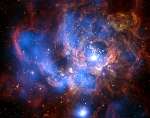
Some 3 million light-years distant in nearby spiral galaxy M33, giant stellar nursery NGC 604 is about 1,300 light-years across, or nearly 100 times the size of the Orion Nebula. In fact, among...
 Looking Sideways from the Parker Solar Probe
9.12.2019
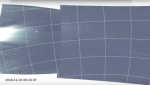
Everybody sees the Sun. Nobody's been there. Starting in 2018 though, NASA launched the robotic Parker Solar Probe (PSP) to investigate regions near to the Sun for the first time. The PSP's looping orbit brings it yet closer to the Sun each time around -- every few months.
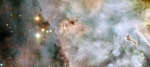 Massive Stars Resolved in the Carina Nebula
1.12.2008
How massive can stars be? Big, hefty stars live short violent lives that can profoundly affect their environments. Isolating a massive star can be problematic, however, since what seems to be a single bright star might actually turn out to be several stars close together.
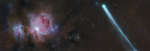 APOD: 2026 May 12 Б The Conjunction of Comet R3 PanSTARRS and the Orion Nebula
12.05.2026
TodayБs composite image features something old, something new, something borrowed, and something blue! Comet R3 PanSTARRS, streaking across the right of the image, likely originated from the Oort Cloud, meaning it is an old Solar System relic from billions of years ago.
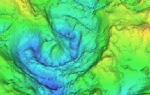 Impact! 65 Million Years Ago
4.06.1996
What killed the dinosaurs? Their sudden disappearence 65 million years ago, along with about 70 percent of all species then living on Earth, is known as the K-T event (Cretaceous-Tertiary Mass Extinction event). Geologists and paleontologists often entertain the idea of a large asteroid or comet impacting the Earth as the culprit.
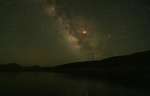 A Total Lunar Eclipse Over Tajikistan
5.10.2014
If the full Moon suddenly faded, what would you see? The answer during the total lunar eclipse of 2011 June was recorded in a dramatic time lapse video from Tajikistan. During a total lunar eclipse, the Earth moves between the Moon and the Sun, causing the moon to fade dramatically.
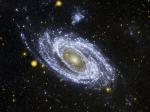 Bright Spiral Galaxy M81 in Ultraviolet from Galex
15.05.2007
Where are the hot stars in M81, one of the closest major spiral galaxies? To help find out, astronomers took a deep image in ultraviolet light of the sprawling spiral with the Earth-orbiting Galex telescope.
|
January February March April May June July August September October |
|||||||||||||||||||||||||||||||||||||||||||||||||