
|
You entered: young stars
 The North America Nebula in Infrared
14.02.2011
The North America Nebula can do what most North Americans cannot -- form stars. Precisely where in the nebula these stars are forming has been mostly obscured by some of the nebula's thick dust that is opaque to visible light.
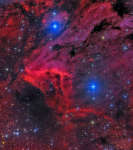 The Pelican Nebula in Red and Blue
28.02.2021
The Pelican Nebula is changing. The entire nebula, officially designated IC 5070, is divided from the larger North America Nebula by a molecular cloud filled with dark dust. The Pelican, however, is particularly interesting because it is an unusually active mix of star formation and evolving gas clouds.
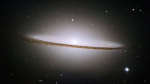 The Sombrero Galaxy from Hubble
15.05.2011
What's going on in the center of this spiral galaxy? Named the Sombrero Galaxy for its hat-like resemblance, M104 features a prominent dust lane and a bright halo of stars and globular clusters.
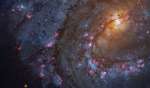 In the Arms of M83
11.11.2011
Big, bright, and beautiful, spiral galaxy M83 lies a mere twelve million light-years away, near the southeastern tip of the very long constellation Hydra. This cosmic close-up, a mosaic based on data from...
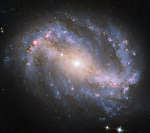 Barred Spiral Galaxy NGC 6217
27.12.2009
Many spiral galaxies have bars across their centers. Even our own Milky Way Galaxy is thought to have a modest central bar. Prominently barred spiral galaxy NGC 6217, pictured above, was captured in spectacular detail in this recently released image taken by the newly repaired Advanced Camera for Surveys on the orbiting Hubble Space Telescope.
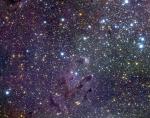 M16: Stars, Pillars and the Eagle s EGGs
2.01.2002
The Hubble Space Telescope's 1995 image of pillars of dust and gas, light-years long, within the Eagle Nebula (M16) was sensational. The three prominent pillars in that close-up visible light picture also appear...
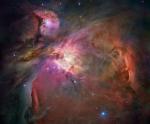 Orion Nebula, The Hubble View
18.01.2006
Few cosmic vistas excite the imagination like the Orion Nebula. Also known as M42, the nebula's glowing gas surrounds hot young stars at the edge of an immense interstellar molecular cloud only 1,500 light-years away.
 NGC 5195: The Dot under the Question Mark
31.08.2013
Dwarf galaxy NGC 5195 is best known as the smaller companion of spiral M51, the Whirlpool galaxy. Seen together they seem to trace the curve and dot of a cosmic question mark, recorded in Lord Rosse's 19th century drawings as one of the original spiral nebulae.
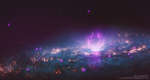 X Ray Superbubbles in Galaxy NGC 3079
4.03.2019
What created these huge galactic superbubbles? Two of these unusual bubbles, each spanning thousands of light-years, were recently discovered near the center of spiral galaxy NGC 3079. The superbubbles, shown in purple on the image right, are so hot they emit X-rays detected by NASA's Earth-orbiting Chandra X-Ray Observatory.
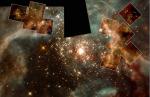 Massive Stars Of 30 Doradus
30.09.1999
This gorgeous visible-light Hubble Space Telescope image shows a young cluster of massive stars at the center of the 30 Doradus Nebula. Gas and dust clouds in 30 Doradus, also known as the Tarantula Nebula, have been sculpted into elongated shapes by powerful winds and ultraviolet radiation from these hot cluster stars.
|
January February March April May June July August September October |
|||||||||||||||||||||||||||||||||||||||||||||||||