
|
You entered: spiral galaxy
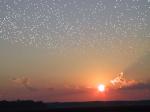 A Flock of Stars
13.12.2003
Only a few stars can be found within ten light-years of our lonely Sun, situated near an outer spiral arm of the Milky Way galaxy. But if the Sun were found within one of our galaxy's star clusters, thousands of stars might occupy a similar space.
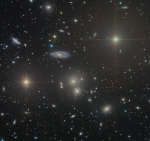 APOD: 2026 June 5 Б The Hydra Cluster of Galaxies
5.06.2026
Within our own Milky Way galaxy, two bright, spiky stars stand like sentinels in the foreground of this cosmic snapshot. Far beyond them are the galaxies of the Hydra Cluster. In fact, while the spiky foreground stars are hundreds of light-years distant, the Hydra Cluster galaxies are well over 100 million light-years away.
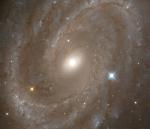 NGC 4603 and the Expanding Universe
27.05.1999
NGC 4603, a galaxy with majestic spiral arms and intricate dust lanes, is 108 million light-years away. Its distance has been accurately measured by astronomers using one of the fundamental yardsticks of the extragalactic distance scale - pulsating variable stars known as Cepheids.
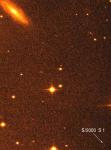 New Moons For Saturn
3.11.2000
Which planet has the most moons? For now, it's Saturn. Four newly discovered satellites bring the ringed planet's total to twenty-two, just edging out Uranus' twenty-one for the most known moons in the solar system. Of course, the newfound Saturnian satellites are not large and photogenic.
 Galaxies in the River
10.02.2016
Large galaxies grow by eating small ones. Even our own galaxy practices galactic cannibalism, absorbing small galaxies that get too close and are captured by the Milky Way's gravity. In fact, the practice...
 Galaxies in the River
10.05.2018
Large galaxies grow by eating small ones. Even our own galaxy practices galactic cannibalism, absorbing small galaxies that get too close and are captured by the Milky Way's gravity. In fact, the practice...
 Galaxies in Pegasus
24.11.2007
This wide, sharp telescopic view reveals galaxies scattered beyond the stars near the northern boundary of the high-flying constellation Pegasus. Prominent at the upper right is NGC 7331. A mere 50 million light-years away, the large spiral is one of the brighter galaxies not included in Charles Messier's famous 18th century catalog.
 The Hydra Cluster of Galaxies
12.05.2012
Two stars within our own Milky Way galaxy anchor the foreground of this cosmic snapshot. Beyond them lie the galaxies of the Hydra Cluster. In fact, while the spiky foreground stars are hundreds of light-years distant, the Hydra Cluster galaxies are over 100 million light-years away.
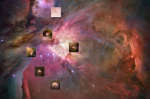 Planetary Systems Now Forming in Orion
22.12.2009
How do planets form? To help find out, the Hubble Space Telescope was tasked to take a detailed look at one of the more interesting of all astronomical nebulae, the Great Nebula in Orion.
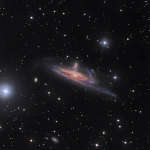 Galaxies in the River
8.01.2020
Large galaxies grow by eating small ones. Even our own galaxy engages in a sort of galactic cannibalism, absorbing small galaxies that are too close and are captured by the Milky Way's gravity.
|
January February March April May June July August September October |
|||||||||||||||||||||||||||||||||||||||||||||||||