
|
You entered: Horsehead Nebula
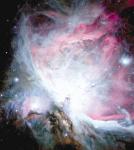 The Orion Nebula from CFHT
14.03.2004
Few astronomical sights excite the imagination like the nearby stellar nursery known as the Orion Nebula. The Nebula's glowing gas surrounds hot young stars at the edge of an immense interstellar molecular cloud only 1500 light-years away.
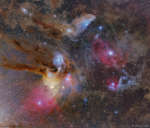 Rho Ophiuchi Wide Field
12.05.2019
The colorful clouds surrounding the star system Rho Ophiuchi compose one of the closest star forming regions. Rho Ophiuchi itself is a binary star system visible in the blue reflection nebula just to the left of the image center.
 APOD: 2023 October 10 Б Hidden Orion from Webb
9.10.2023
The Great Nebula in Orion has hidden stars. To the unaided eye in visible light, it appears as a small fuzzy patch in the constellation of Orion. But this image was taken by the Webb Space Telescope in a representative-color composite of red and very near infrared light.
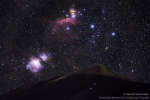 Orions Belt and Sword over Teides Peak
27.03.2016
The southern part of Orion, the famous constellation and mythical hunter, appears quite picturesque posing here over a famous volcano. Located in the Canary Islands off the northwest coast of Africa, the snow-peaked Teide is one of the largest volcanoes on Earth.
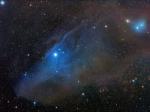 Horse Head Shaped Reflection Nebula IC 4592
8.08.2006
Do you see the horse's head? What you are seeing is not the famous Horsehead nebula toward Orion but rather a fainter nebula that only takes on a familiar form with deeper imaging. The main part of the above imaged molecular cloud complex is a reflection nebula cataloged as IC 4592.
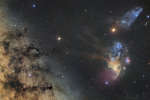 Saturn and Mars visit Milky Way Star Clouds
9.05.2016
Planets, stars, nebulas and a galaxy -- this impressive image has them all. Closest to home are the two planets Mars (right) and Saturn (center), visible as the two bright orange spots in the upper half of the featured image.
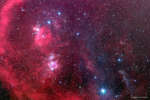 Southern Orion: From Belt to Witch
8.04.2008
Do you recognize the belt of Orion in this image? The familiar trio of stars, visible to the unaided eye, can be found across the upper left. Otherwise, the southern part of the constellation...
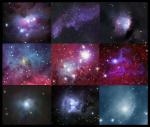 Starlight Reflections
27.12.2001
Interstellar dust grains often find themselves in a reflective "mood". Near a bright star, clouds of these dust particles scatter short wavelengths of visible starlight more readily than long wavelengths, producing lovely blue reflection nebulae. Nine of the more spectacular examples of these dusty, blue stellar neighborhoods have been assembled here by astrophotographer Rob Gendler.
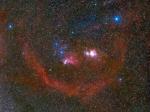 Barnards Loop Around Orion
20.04.2005
Why is the belt of Orion surrounded by a bubble? Although glowing like an emission nebula, the origin of the bubble, known as Barnard's Loop, is currently unknown. Progenitor hypotheses include the winds from bright Orion stars and the supernovas of stars long gone.
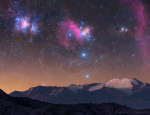 Orion over Argentine Mountains
8.06.2020
Do you recognize the constellation of Orion? It may be harder than usual in today's featured image because the camera has zoomed in on the center, and the exposure is long enough to enhance nebulas beyond what the unaided human eye can see.
|
January February March April May June July August September October |
|||||||||||||||||||||||||||||||||||||||||||||||||