
|
You entered: Saturn's Moon
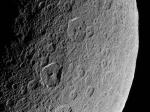 Ancient Craters on Saturns Rhea
30.05.2006
Saturn's ragged moon Rhea has one of the oldest surfaces known. Estimated as changing little in the past billion years, Rhea shows craters so old they no longer appear round their edges have become compromised by more recent cratering.
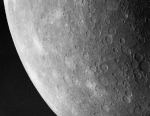 Southwest Mercury
13.09.1996
The planet Mercury resembles a moon. Mercury's old surface is heavily cratered like many moons. Mercury is larger than most moons but smaller than Jupiter's moon Ganymede and Saturn's moon Titan. Mercury is much denser and more massive than any moon, though, because it is made mostly of iron.
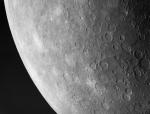 Southwest Mercury
16.02.2003
The planet Mercury resembles a moon. Mercury's old surface is heavily cratered like many moons. Mercury is larger than most moons but smaller than Jupiter's moon Ganymede and Saturn's moon Titan. Mercury is much denser and more massive than any moon, though, because it is made mostly of iron.
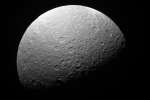 Ancient Craters of Southern Rhea
13.05.2008
Saturn's ragged moon Rhea has one of the oldest surfaces known. Estimated as changing little in the past billion years, Rhea shows craters so old they no longer appear round their edges have become compromised by more recent cratering.
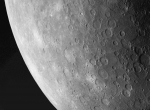 Southwest Mercury
13.02.2000
The planet Mercury resembles a moon. Mercury's old surface is heavily cratered like many moons. Mercury is larger than most moons but smaller than Jupiter's moon Ganymede and Saturn's moon Titan. Mercury is much denser and more massive than any moon, though, because it is made mostly of iron.
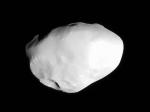 An Unusually Smooth Surface on Saturns Telesto
22.02.2006
Why is Saturn's small moon Telesto so smooth? Possibly Telesto is covered with a type of granular icy material similar to that suspected of covering Pandora, another of Saturn's small moon's. If so, Telesto might be more like a pile of rubble than a solid body.
 APOD: 2025 November 16 Б Crossing Saturns Ring Plane
16.11.2025
If this is Saturn, where are the rings? When Saturn's "appendages" disappeared in 1612, Galileo did not understand why. Later that century, it became understood that Saturn's unusual protrusions were rings and that when the Earth crosses the ring plane, the edge-on rings will appear to disappear.
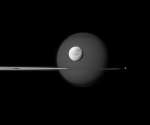 In Through and Beyond Saturns Rings
26.10.2011
A fourth moon is visible on the above image if you look hard enough. First -- and furthest in the background -- is Titan, the largest moon of Saturn and one of the larger moons in the Solar System. The dark feature across the top of this perpetually cloudy world is the north polar hood.
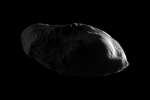 Prometheus Remastered
5.04.2010
What does Saturn's shepherd moon Prometheus really look like? The raw images from the robotic Cassini spacecraft's January flyby of the small moon showed tantalizing clues on grainy images, but now that the Cassini team has digitally remastered these images, many more details have come out.
 APOD: 2025 July 24 Б Titan Shadow Transit
24.07.2025
Every 15 years or so, Saturn's rings are tilted edge-on to our line of sight. As the bright, beautiful ring system grows narrower and fainter it becomes increasingly difficult to see for denizens of planet Earth.
|
January February March April May June July August September October |
|||||||||||||||||||||||||||||||||||||||||||||||||