
|
You entered: Scorpius
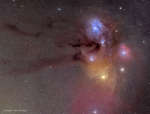 The Dark River to Antares
21.02.2015
Connecting the Pipe Nebula to the colorful region near bright star Antares is a dark cloud dubbed the Dark River, flowing from the picture's left edge. Murky looking, the Dark River's appearance is caused by dust obscuring background starlight, although the dark nebula contains mostly hydrogen and molecular gas.
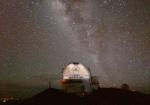 A Gemini Sky
9.09.2003
Where will Gemini take us tonight? It is dusk and Gemini North, one of the largest telescopes on planet Earth, prepares to peer into the distant universe. Gemini's flexible 8.1-mirror has taken...
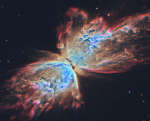 The Butterfly Nebula from Hubble
1.10.2014
The bright clusters and nebulae of planet Earth's night sky are often named for flowers or insects. Though its wingspan covers over 3 light-years, NGC 6302 is no exception. With an estimated surface...
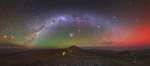 Milky Way with Airglow Australis
3.02.2017
Captured last April after sunset on a Chilean winter's night an exceptionally intense airglow flooded this scene. The panoramic skyscape is also filled with stars, clusters, and nebulae along the southern Milky Way including the Large and Small Magellanic clouds.
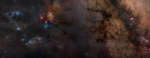 Dark River Wide Field
19.07.2010
A Dark River of dust seems to run from our Galactic Center, then pool into a starfield containing photogenic sky wonders. Scrolling right will reveal many of these objects including (can you find?)...
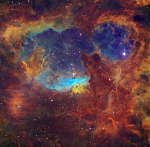 Massive Stars in NGC 6357
5.02.2016
Massive stars lie within NGC 6357, an expansive emission nebula complex some 6,500 light-years away toward the tail of the constellation Scorpius. In fact, positioned near center in this ground-based close-up...
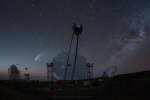 MAGIC NEOWISE
24.07.2020
The multi-mirror, 17 meter-diameter MAGIC telescopes reflect this starry night sky from the Roque de los Muchachos European Northern Observatory on the Canary Island of La Palma. MAGIC stands for Major Atmospheric Gamma Imaging...
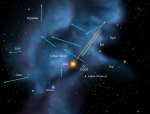 The Local Fluff
24.09.2013
The stars are not alone. In the disk of our Milky Way Galaxy about 10 percent of visible matter is in the form of gas, called the interstellar medium (ISM). The ISM is not uniform, and shows patchiness even near our Sun.
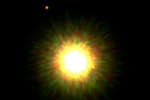 Companion of a Young, Sun-like Star Confirmed
4.07.2010
The first direct image of an extrasolar planet orbiting a star similar to our Sun has been confirmed. Located just 500 light-years away toward the constellation Scorpius, the parent star, cataloged as 1RXS J160929.1-210524, is only slightly less massive and a little cooler than the Sun.
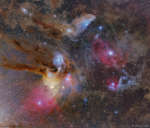 Rho Ophiuchi Wide Field
13.05.2019
The colorful clouds surrounding the star system Rho Ophiuchi compose one of the closest star forming regions. Rho Ophiuchi itself is a binary star system visible in the blue reflection nebula just to the left of the image center.
|
January February March April May June July August September October |
|||||||||||||||||||||||||||||||||||||||||||||||||