
|
You entered: Spitzer space telescope
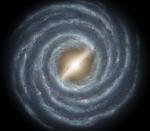 Barred Spiral Milky Way
25.08.2005
A recent survey of stars conducted with the Spitzer Space Telescope is convincing astronomers that our Milky Way Galaxy is not just your ordinary spiral galaxy anymore. Looking out from within the Galaxy's disk, the true structure of the Milky Way is difficult to discern.
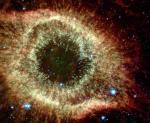 Infrared Helix
12.01.2006
Over six hundred light years from Earth, in the constellation Aquarius, a sun-like star is dying. Its last few thousand years have produced the Helix Nebula (NGC 7293), a well studied and nearby example of a Planetary Nebula, typical of this final phase of stellar evolution.
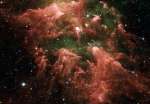 Sculpting the South Pillar
13.03.2008
Eta Carinae, one of the most massive and unstable stars in the Milky Way Galaxy, has a profound effect on its environment. Found in the the South Pillar region of the Carina Nebula, these...
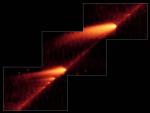 Crumbling Comet
13.05.2006
This false-color mosaic of crumbling comet Schwassmann-Wachmann 3 spans about 6 degrees (12 full moons) along the comet's orbit. Recorded on May 4-6 by an infrared camera on board the Spitzer Space Telescope, the picture captures about 45 of the 60 or more alphabetically cataloged large comet fragments.
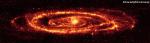 The Andromeda Galaxy in Infrared
20.10.2005
What is the Andromeda galaxy really like? To find out, astronomers looked at our largest galactic neighbor in a different light: infrared. Astronomers trained the orbiting Spitzer Space Telescope at the Messier monster (M31) for over 18 hours, creating a mosaic that incorporated 11,000 separate exposures.
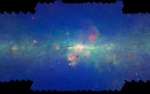 Spitzer s Milky Way
5.06.2008
The Spitzer Space Telescope's encompasing infrared view of the plane of our Milky Way Galaxy is hard to appreciate in just one picture. In fact, more than 800,000 frames of data from...
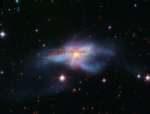 NGC 6240: Merging Galaxies
18.06.2009
NGC 6240 offers a rare glimpse of a cosmic catastrophe in its final throes. The titanic galaxy-galaxy collision is located a mere 400 million light-years away in the constellation Ophiuchus. One of the brightest...
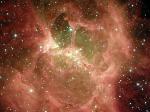 Spooky Star Forming Region DR 6
1.11.2004
How could stars form such a spooky and familiar shape as a human skull? First, the complex process of star formation creates nebulas of many shapes and sizes -- it is human perception that identifies the skull shape.
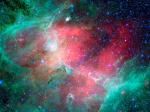 The Eagle Nebula in Infrared
11.01.2007
In visible light, the whole thing looks like an eagle. The region was captured recently in unprecedented detail in infrared light by the robotic orbiting Spitzer Space Telescope (SSC). Shown above, the infrared image...
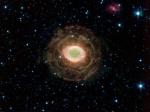 Infrared Ring Nebula
11.03.2005
The classic appearance of the popular Ring Nebula (aka M57) is understood to be due to perspective - our view from planet Earth looks down the center of a roughly barrel-shaped cloud of gas.
|
January February March April May June July August September October |
|||||||||||||||||||||||||||||||||||||||||||||||||