
|
You entered: Sun
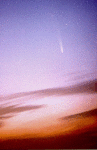 The Sun Sets on Comet Hyakutake
28.04.1996
Comet Hyakutake is seen here just as the Sun sets on April 22. As April draws to a close, Comet Hyakutake will be visible only just after sunset and will be hard to discern against the brightly lit sky.
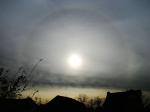 A Sun Halo Over Tennessee
9.03.2005
Sometimes it looks like the Sun is being viewed through a large lens. In the above case, however, there are actually millions of lenses: ice crystals. As water freezes in the upper atmosphere, small, flat, six-sided, ice crystals might be formed.
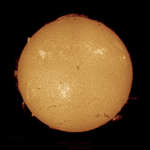 Perihelion Sun 2023
14.01.2023
Perihelion for 2023, Earth's closest approach to the Sun, was on January 4 at 16:17 UTC. That was less than 24 hours after this sharp image of the Sun's disk was recorded with telescope and H-alpha filter from Sidney, Australia, planet Earth.
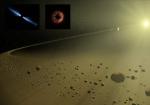 Debris Disks Surround Distant Suns
10.12.2004
In this dramatic artist's vision, debris along the outer reaches of a planet forming disk orbits in the glare of a distant sun. But inset are actual images of such disks around two nearby stars - AU Microscopii (top left; edge-on) and HD107146 (right: face-on) - as seen by the Hubble Space Telescope.
 The Suns Surface in 3D
24.06.2003
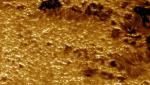
How smooth is the Sun? The new Swedish 1-m Solar Telescope, deployed in the Canary Islands only last year, allows imaging of objects less than 100-km across on the Sun's surface. When pointed toward the Sun's edge, surface objects now begin to block each other, indicating true three-dimensional information.
 APOD: 2025 September 25 Б Saturn Opposite the Sun
25.09.2025
This year Saturn was at opposition on September 21, opposite the Sun in planet Earth's sky. At its closest to Earth, Saturn was also at its brightest of the year, rising as the Sun set and shining above the horizon all night long among the fainter stars of the constellation Pisces.
 Movie: The Active Sun
4.12.2006
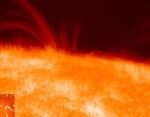
Plumes of hot gas shoot across the surface on even an average day on the Sun. Such volatile activity was captured in dramatic detail recently by the new Hinode satellite launched by Japan in late September.
 Prominences and Filaments on the Active Sun
15.06.2024
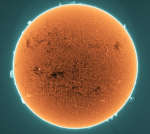
This colorized and sharpened image of the Sun is composed of frames recording emission from hydrogen atoms in the solar chromosphere on May 15. Approaching the maximum of solar cycle 25, a multitude of active regions and twisting, snake-like solar filaments are seen to sprawl across the surface of the active Sun.
 Station and Shuttle Transit the Sun
23.05.2010
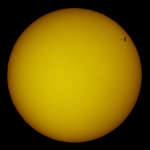
That's no sunspot. On the upper right of the above image of the Sun, the dark patches are actually the International Space Station (ISS) and the Space Shuttle Atlantis on mission STS-132.
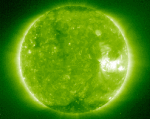 The Iron Sun
21.05.1996
The ultraviolet light emitted by eleven times ionized iron at temperatures over 2 million degrees Farenheit was used to record the above picture of the Sun on May 16. The image was made by the EIT camera onboard the SOHO spacecraft, a space observatory which can continuously observe the Sun.
|
January February March April May June July August September October |
|||||||||||||||||||||||||||||||||||||||||||||||||