
|
You entered: active Sun
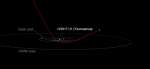 Unexpected Trajectory Interstellar Asteroid Oumuamua
19.11.2018
Why is 'Oumuamua differing from its expected trajectory? Last year, 1I/2017 U1 'Oumuamua became the first known asteroid from interstellar space to pass through our Solar System. Just over a year ago, this tumbling interstellar rock even passed rather close to the Earth.
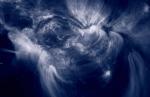 Solar Moss
26.12.1999
Discovered in recent close-up pictures of the Sun from NASA's Transition Region And Coronal Explorer (TRACE) spacecraft, this spongy-looking stuff has a temperature of 2 million degrees Fahrenheit ... and has been dubbed "Solar Moss". The false-color TRACE image above was recorded in extreme ultraviolet light on October 18.
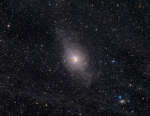 Centaurus A
8.03.2017
Only 11 million light-years away, Centaurus A is the closest active galaxy to planet Earth. Spanning over 60,000 light-years, the peculiar elliptical galaxy also known as NGC 5128, is featured in this sharp telescopic view.
 Large Sunspot Groups 10484 and 10486
26.10.2003
Two unusually large sunspot groups are now crossing the face of the Sun. Each group, roughly the size of Jupiter, is unusual not only for its size but because it is appearing over three years after solar maximum, the peak of solar surface activity.
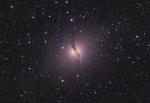 Jumbled Galaxy Centaurus A
30.06.2007
At the center of this sharp skyscape, Centaurus A seems to be a fantastic jumble of old yellow stars, young blue star clusters, and imposing dark dust lanes. Spanning over 60,000 light-years, the peculiar elliptical galaxy is apparently the result of a collision of two otherwise normal galaxies.
 Equinox 1
30.03.2001
Twice a year, at the Spring and Fall equinox, the Sun rises due east. In an emphatic demonstration of this celestial alignment, photographer Joe Orman recorded this inspiring image of the Sun rising exactly along the east-west oriented Western Canal, in Tempe, Arizona, USA.
 APOD: 2023 April 19 Б Auroral Storm over Lapland
18.04.2023
On some nights the sky is the best show in town. On this night, auroras ruled the sky, and the geomagnetic storm that created this colorful sky show originated from an increasingly active Sun.
 Welcome to Perihelion
3.01.2025
Earth's orbit around the Sun is not a circle, it's an ellipse. The point along its elliptical orbit where our fair planet is closest to the Sun is called perihelion. This year perihelion is today, January 4, at 13:28 UTC, with the Earth about 147 million kilometers from the Sun.
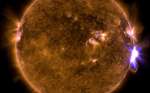 Flare Well AR2673
13.09.2017
Almost out of view from our fair planet, rotating around the Sun's western edge giant active region AR2673 lashed out with another intense solar flare followed by a large coronal mass ejection on September 10.
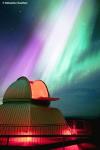 Mount Megantic Magnetic Storm
17.08.2000
Plasma from the Sun and debris from a comet both collided with planet Earth last Saturday morning triggering magnetic storms and a meteor shower in a dazzling atmospheric spectacle. The debris stream from comet...
|
January February March April May June July August September |
|||||||||||||||||||||||||||||||||||||||||||||||||