
|
You entered: active region
 Northern Lights, September Skies
16.09.2005
So far, the Aurora Borealis or Northern Lights have made some remarkable visits to September's skies. The reason, of course, is the not-so-quiet Sun. In particular, a large solar active region now crossing...
 A Transit of Mercury
12.05.2016
On May 9, the diminutive disk of Mercury spent about seven and a half hours crossing in front of the Sun as viewed from the general vicinity of Earth. It was the second of 14 transits of the Solar System's innermost planet in the 21st century.
 Aurora Over Edmonton
4.11.2003
Northern and southern locales saw many a beautiful aurora over the last week, as particles from several large solar flares impacted the Earth. Many reported unusually red auroras, although colors across the spectrum were also seen. Power grids and orbiting satellites braced for the onslaught, but little lasting damage was reported.
 APOD: 2023 May 17 Б Sunspot with Light Bridge
17.05.2023
Why would a small part of the Sun appear slightly dark? Visible is a close-up picture of sunspots, depressions on the Sun's surface that are slightly cooler and less bright than the rest of the Sun. The Sun's complex magnetic field creates these cool regions by inhibiting hot material from entering the spots.
 APOD: 2024 May 26 Б A Solar Filament Erupts
26.05.2024
What's happened to our Sun? Nothing very unusual -- it just threw a filament. Toward the middle of 2012, a long standing solar filament suddenly erupted into space, producing an energetic coronal mass ejection (CME).
 AR 9169: A Large Sunspot
25.09.2000
One of the largest sunspots in recent years is now crossing our Sun. Dominating active region AR 9169, the sunspot is the large dark complex visible below (west) and right of center in the above photograph of our Sun taken last Thursday.
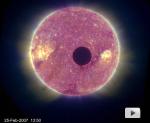 Lunar Transit from STEREO
3.03.2007
A million miles from planet Earth, last weekend the STEREO B spacecraft found itself in the shadow of the Moon. So, looking toward the Sun, extreme ultraviolet cameras onboard STEREO B were able to record a stunning movie of a lunar transit (aka solar eclipse), as the Moon tracked across the solar disk.
 APOD: 2023 December 11 Б Solar Minimum versus Solar Maximum
11.12.2023
The surface of our Sun is constantly changing. Some years it is quiet, showing relatively few sunspots and active regions. Other years it is churning, showing many sunspots and throwing frequent Coronal Mass Ejections (CMEs) and flares.
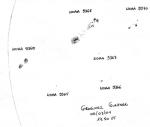 Islands in the Photosphere
15.03.2001
Awash in a sea of plasma and anchored in magnetic fields, sunspots are planet-sized, dark islands in the solar photosphere, the bright surface of the Sun. Before the enlightened(!) age of cameras, solar observers created detailed drawings of sunspots as they changed and progressed across the visible solar disk.
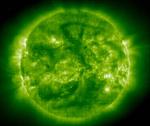 S is for Sun
21.03.2002
Taken yesterday from the SOHO spacecraft, this false-color image shows the active Sun near the March Equinox, the beginning of Fall in the south and Spring in the northern hemisphere. Recorded in a band...
|
January February March April May June July August September |
|||||||||||||||||||||||||||||||||||||||||||||||||