
|
You entered: astronomy
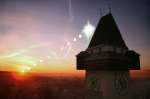 Sunrise, Moonrise
6.01.2011
For many Europeans, the Sun and New Moon rose together on January 4 in a partial solar eclipse. Arriving close on the heels of the new year, it was the first of a series of four(!) partial solar eclipses due in 2011.
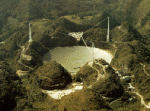 Arecibo: The Largest Telescope
12.04.1997
The Arecibo radio telescope is currently the largest single-dish telescope in the world. First opening in 1963, this 305 meter (1000 foot) radio telescope resides in a natural valley of Puerto Rico. The Arecibo telescope has been used for many astronomical research projects, including
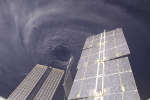 Hurricane Ivan from the Space Station
13.01.2008
Ninety percent of the houses on Grenada were damaged by the destructive force of Hurricane Ivan. At its peak, Ivan was a Category 5 hurricane, the highest power category on the Saffir-Simpson Scale, and created sustained winds in excess of 200 kilometers per hour.
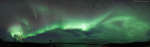 Northern Lights over Prelude Lake
17.09.2010
Curtains of shimmering green light sprawl across this gorgeous night skyscape. In the foreground lies the peaceful Prelude Lake, located about 30 kilometers east of Yellowknife, Northwest Territories, Canada. From high northern latitudes these mesmerizing northern lights, also known as the aurora borealis, are becoming a more familiar sight.
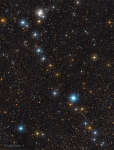 APOD: 2023 January 3 Б Kembles Cascade of Stars
3.01.2023
This line of stars is real. A little too faint to see with the unaided eye, KembleБs Cascade of stars inspires awe when seen with binoculars. Like the Big Dipper though, KembleБs Cascade is an asterism, not a constellation. The asterism is visible in the northern sky toward the long-necked constellation of the Giraffe (Camelopardalis).
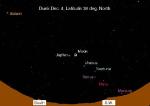 A Sky Full Of Planets
4.12.1997
Look up tonight. Just after sunset, the crescent moon and all five "naked-eye" planets (Mercury, Venus, Mars, Jupiter, and Saturn) will be visible (depending on your latitude), lying near our solar system's ecliptic plane.
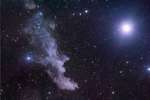 A Witch by Starlight
31.10.2008
By starlight this eerie visage shines in the dark, a crooked profile evoking its popular name, the Witch Head Nebula. In fact, this entrancing telescopic portrait gives the impression the witch has fixed her gaze on Orion's bright supergiant star Rigel.
 APOD: 2025 February 4 Б Anticrepuscular Rays: A Rainbow Fan over Spain
4.02.2025
Yes, but can your rainbow do this? Late in the day, the Sun set as usual toward the west. However, on this day, the more interesting display was 180 degrees around -- toward the east. There, not only was a rainbow visible, but an impressive display of anticrepuscular rays from the rainbow's center.
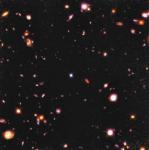 The Hubble Deep Field in Infrared
12.10.1998
Galaxies this faint have never been seen before. In 1996 the Hubble Space Telescope (HST) created one of the most famous pictures of modern astronomy, the Hubble Deep Field (HDF). Now HST has returned to a piece of the HDF for a long exposure by its new NICMOS camera, sensitive to infrared light.
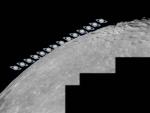 Eclipsing the Rings
16.03.2007
The March 3rd total lunar eclipse was widely viewed by denizens of planet Earth. But only a day before, well placed observers could also watch a lunar occultation of Saturn as the planet passed behind the nearly Full Moon.
|
January February March April May June July August |
||||||||||||||||||||||||||||||||||||||||||||||||||||||||