
|
You entered: cassini spacecraft
 Seeing Titan
31.03.2023
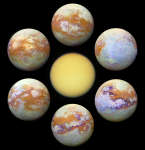
Shrouded in a thick atmosphere, Saturn's largest moon Titan really is hard to see. Small particles suspended in the upper atmosphere cause an almost impenetrable haze, strongly scattering light at visible wavelengths and hiding Titan's surface features from prying eyes.
 Cassini Approaches Saturn
10.04.2016
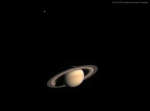
Cassini, a robot spacecraft launched in 1997 by NASA, became close enough in 2002 to resolve many rings and moons of its destination planet: Saturn. At that time, Cassini snapped several images during an engineering test. Several of those images were combined into the contrast-enhanced color composite featured here.
 Crescent Enceladus
9.03.2019
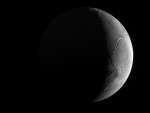
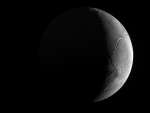
Peering from the shadows, the Saturn-facing hemisphere of tantalizing inner moon Enceladus poses in this Cassini spacecraft image. North is up in the dramatic scene captured during November 2016 as Cassini's camera was pointed in a nearly sunward direction about 130,000 kilometers from the moon's bright crescent.
 APOD: 2026 May 2 Б Seeing Titan
2.05.2026
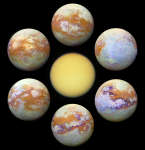
Shrouded in a thick atmosphere, the surface of Saturn's largest moon, Titan, is really hard to see. Small particles suspended in Titan's upper atmosphere cause an almost impenetrable haze, strongly scattering light at visible wavelengths and hiding surface features from prying eyes.
 Crescent Enceladus
16.12.2023
Peering from the shadows, the Saturn-facing hemisphere of tantalizing inner moon Enceladus poses in this Cassini spacecraft image. North is up in the dramatic scene captured during November 2016 as Cassini's camera was pointed in a nearly sunward direction about 130,000 kilometers from the moon's bright crescent.
 Crescent Enceladus
7.02.2026
Peering from the shadows, the Saturn-facing hemisphere of tantalizing inner moon Enceladus poses in this Cassini spacecraft image. North is up in the dramatic scene captured during November 2016 as Cassini's camera was pointed in a nearly sunward direction about 130,000 kilometers from the moon's bright crescent.
 Saturn, Rings, and Two Moons
18.01.1998
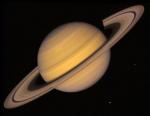
NASA's robot spacecraft Voyager 2 made this image of Saturn as it began to explore the Saturn system in 1981. Saturn's famous rings are visible along with two of its moons, Rhea and Dione which appear as faint dots on the right and lower right part of the picture.
 Take a Picture of Saturn
19.07.2013
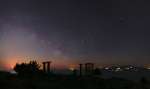
Take a picture of Saturn in the sky tonight. You could capture a view like this one. Recorded just last month looking toward the south, planet Earth and ruins of the ancient temple of Athena at Assos, Turkey are in the foreground.
 Cassini Looks Out from Saturn
30.04.2017
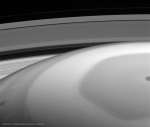
This is what Saturn looks like from inside the rings. Last week, for the first time, NASA directed the Cassini spacecraft to swoop between Saturn and its rings. During the dive, the robotic spacecraft took hundreds of images showing unprecedented detail for structures in Saturn's atmosphere.
 Ringside
21.10.2005
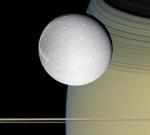
Orbiting in the plane of Saturn's rings, Dione and the other icy saturnian moons have a perpetual ringside view of the gorgeous gas giant planet. Of course, while passing through the ring plane the Cassini spacecraft also shares their stunning perspective.
|
January February March April May June July August September October |
|||||||||||||||||||||||||||||||||||||||||||||||||