
|
You entered: distance scale
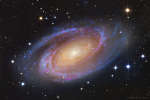 Bright Spiral Galaxy M81
18.11.2014
One of the brightest galaxies in planet Earth's sky is similar in size to our Milky Way Galaxy: big, beautiful M81. This grand spiral galaxy can be found toward the northern constellation of the Great Bear (Ursa Major).
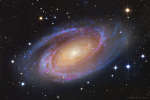 Bright Spiral Galaxy M81
17.09.2017
One of the brightest galaxies in planet Earth's sky is similar in size to our Milky Way Galaxy: big, beautiful M81. This grand spiral galaxy can be found toward the northern constellation of the Great Bear (Ursa Major).
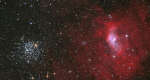 The Bubble and the Star Cluster
25.09.2021
To the eye, this cosmic composition nicely balances the Bubble Nebula at the right with open star cluster M52. The pair would be lopsided on other scales, though. Embedded in a complex of interstellar...
 The Bubble and M52
8.10.2013
To the eye, this cosmic composition nicely balances the Bubble Nebula at the lower left with open star cluster M52 above it and to the right. The pair would be lopsided on other scales, though.
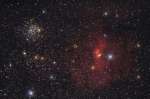 The Bubble and M52
14.09.2011
To the eye, this cosmic composition nicely balances the Bubble Nebula at the lower right with open star cluster M52. The pair would be lopsided on other scales, though. Embedded in a complex...
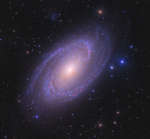 Bright Spiral Galaxy M81
17.10.2015
One of the brightest galaxies in planet Earth's sky is similar in size to our Milky Way Galaxy: big, beautiful M81. The grand spiral galaxy can be found toward the northern constellation of the Great Bear (Ursa Major).
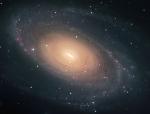 Bright Galaxy M81
20.06.2002
Big and beautiful spiral galaxy M81, in the northern constellation Ursa Major, is one of the brightest galaxies visible in the skies of planet Earth. This superbly detailed view reveals its bright nucleus, grand spiral arms and sweeping cosmic dust lanes with a scale comparable to the Milky Way.
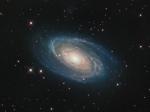 Bright Galaxy M81
7.07.2006
Big and beautiful spiral galaxy M81 lies in the northern constellation Ursa Major. One of the brightest galaxies in planet Earth's sky, M81 is also home to the second brightest supernova seen in modern times.
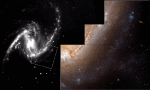 Hubble's Constant And The Expanding Universe (I)
13.05.1996
Our Universe is expanding. Distant galaxies appear to recede from us at ever-increasing speeds. What is the rate of expansion? How long has it been expanding? What will be its ultimate fate? Two groups of astronomers are searching vigorously for answers to these fundamental questions using the Hubble Space Telescope (HST).
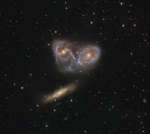 APOD: 2026 July 3 Б Three Galaxies in Pavo
3.07.2026
Some 190 million light-years away, far beyond the bright stars and nebulae of the Milky Way, these three galaxies are drawn together by gravity in a mesmerizing cosmic dance. Clearly distorted by galactic-scale gravitational interactions, large spiral galaxies NGC6769 and NGC6770 are seen face-on, with luminous galactic disks scarred by obscuring interstellar dust lanes.
|
January February March April May June July August September October |
|||||||||||||||||||||||||||||||||||||||||||||||||