
|
You entered: face
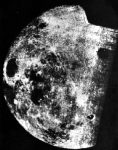 The Far Side
14.09.1995
This historic picture was humanity's first glimpse of the far side of the Moon. It was taken by the Soviet spacecraft Luna 3 in October of 1959. Luna 3 followed closely...
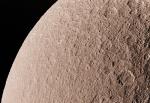 Rhea: Saturn's Second Largest Moon
8.06.2003
Rhea is the second largest moon of Saturn, behind Titan, and the largest without an atmosphere. It is composed mostly of water ice, but has a small rocky core. Rhea's rotation and orbit are locked together (just like Earth's Moon) so that one side always faces Saturn.
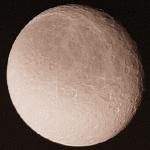 Rhea: Saturn's Second Largest Moon
14.10.1995
Rhea is the second largest moon of Saturn, behind Titan, and the largest without an atmosphere. It is composed mostly of water ice, but has a small rocky core. Rhea's rotation and orbit are locked together (just like Earth's Moon) so that one side always faces Saturn.
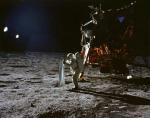 Apollo 11: Catching Some Sun
27.07.2002
Bright sunlight glints and long dark shadows dramatize this image of the lunar surface taken by Apollo 11 astronaut Neil Armstrong, the first to walk on the Moon. Pictured is the mission's lunar...
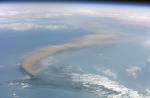 Mt Etna Eruption Plume
2.01.2003
Mt. Etna has been erupting for hundreds of thousands of years. In late October of last year, however, earthquakes triggered a particularly vigorous outburst from this well known volcano on the Italian island of Sicily.
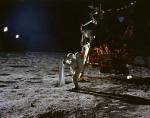 Apollo 11: Catching Some Sun
20.09.2003
Bright sunlight glints and long dark shadows dramatize this image of the lunar surface taken by Apollo 11 astronaut Neil Armstrong, the first to walk on the Moon. Pictured is the mission's lunar...
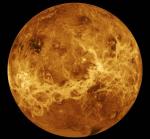 Venus Unveiled
30.03.2002
The surface of Venus is perpetually covered by a veil of thick clouds and remains hidden from even the powerful telescopic eyes of earth-bound astronomers. But in the early 1990s, using imaging radar...
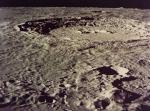 Crater Copernicus
13.05.2001
One of the more prominent craters on the Moon is named Copernicus. Copernicus is a large young crater visible with binoculars slightly northwest of the center of the Moon's Earth-facing hemisphere. Copernicus is distinguished by its size and by the many bright rays pointing out from it.
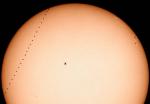 A Mercury Transit Sequence
27.05.2003
Earlier this month, the planet Mercury crossed the face of the Sun, as seen from Earth. Because the plane of Mercury's orbit is not exactly coincident with the plane of Earth's orbit, Mercury usually appears to pass over or under the Sun.
 Lunation
8.11.1999
Our Moon's appearance changes nightly. This slow-loading time-lapse sequence shows what our Moon looks like during a lunation, a complete lunar cycle. As the Moon orbits the Earth, the half illuminated by the Sun first becomes increasingly visible, then decreasingly visible. The Moon always keeps the same face toward the Earth.
|
January February March April May June July August September |
|||||||||||||||||||||||||||||||||||||||||||||||||