
|
You entered: meteors
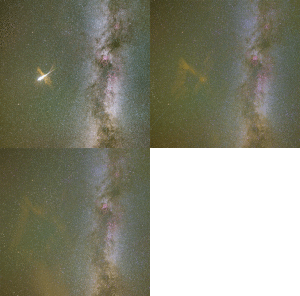 Milky Way and Exploding Meteor
12.08.2015
Tonight the Perseid Meteor Shower reaches its maximum. Grains of icy rock will streak across the sky as they evaporate during entry into Earth's atmosphere. These grains were shed from Comet Swift-Tuttle.
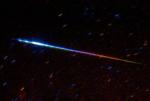 A Perseid Meteor
11.08.2002
The ongoing Perseid Meteor Shower should be at its strongest on August 12 and 13. The best time to watch will be between 2:00 AM and dawn on Monday morning (so plan on setting your alarm tonight!) and then again on Tuesday.
 APOD: 2023 July 24 Б Chemicals Glow as a Meteor Disintegrates
24.07.2023
Meteors can be colorful. While the human eye usually cannot discern many colors, cameras often can. Pictured here is a fireball, a disintegrating meteor that was not only one of the brightest the photographer has ever seen, but colorful.
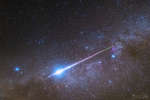 Bright Meteor, Starry Sky
19.08.2021
Plowing through Earth's atmosphere at 60 kilometers per second, this bright perseid meteor streaks along a starry Milky Way. Captured in dark Portugal skies on August 12, it moves right to left through the frame.
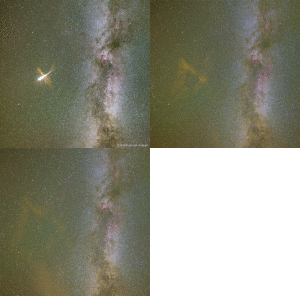 Milky Way and Exploding Meteor
6.08.2017
Next weekend the Perseid Meteor Shower reaches its maximum. Grains of icy rock will streak across the sky as they evaporate during entry into Earth's atmosphere. These grains were shed from Comet Swift-Tuttle.
 APOD: 2025 December 15 Б Gemini Meteors over Snow Capped Mountains
15.12.2025
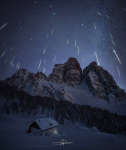
Where are all of these meteors coming from? In terms of direction on the sky, the pointed answer is the constellation of Gemini. That is why the major meteor shower in December is known as the Geminids -- because shower meteors all appear to come from a radiant toward Gemini.
 Gemini s Meteors
17.12.2020
Taken over the course of an hour shortly after local midnight on December 13, 35 exposures were used to create this postcard from Earth. The composited night scene spans dark skies above the snowy Italian Dolomites during our fair planet's annual Geminid meteor shower.
 Perseid Meteors over Mount Shasta
8.08.2016
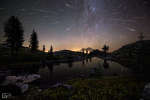
Where are all of these meteors coming from? In terms of direction on the sky, the pointed answer is the constellation of Perseus. That is why the meteor shower that peaks later this week is known as the Perseids -- the meteors all appear to came from a radiant toward Perseus.
 Shuttle and Meteor
14.08.2009
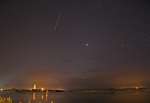
This early morning skyscape was captured last week on August 4th, looking northeast across calm waters in the Turn Basin at NASA's Kennedy Space Center. In a striking contrast in motion, the space...
 Meteors, Comet, and Big Dipper over La Palma
23.04.2019
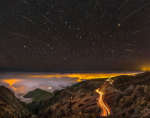
Meteor showers are caused by streams of solid particles, dust size and larger, moving as a group through space. In most cases, the orbits of these meteor streams can be identified with dust expelled from a comet.
|
January February March April May June July August September |
|||||||||||||||||||||||||||||||||||||||||||||||||