
|
You entered: nebula
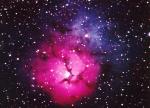 The Trifid Nebula in Red, White and Blue
8.12.1997
Three dark dust lanes give the picturesque Trifid Nebula its name. The red and blue colors of the Trifid Nebula are present in different regions and are created by different processes. A big bright star near the center of the red region appears white hot and emits light so energetic
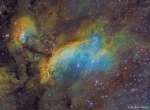 IC 4628: The Prawn Nebula
4.07.2016
South of Antares, in the tail of the nebula-rich constellation Scorpius, lies emission nebula IC 4628. Nearby hot, massive stars, millions of years young, radiate the nebula with invisible ultraviolet light, stripping electrons from atoms. The electrons eventually recombine with the atoms to produce the visible nebular glow, dominated by the red emission of hydrogen.
 APOD: 2023 June 5 Б In the Center of the Trifid Nebula
5.06.2023
What's happening at the center of the Trifid Nebula? Three prominent dust lanes that give the Trifid its name all come together. Mountains of opaque dust appear near the bottom, while other dark filaments of dust are visible threaded throughout the nebula.
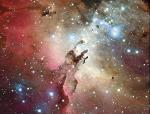 The Eagle Nebula from CFHT
13.02.2003
Bright blue stars are still forming in the dark pillars of the Eagle Nebula. Made famous by a picture from the Hubble Space Telescope in 1995, the Eagle Nebula shows the dramatic process of star formation. To the upper right of the nebula in the above picture lies the heart of the open cluster M16.
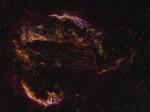 The Veil Nebula Unveiled
6.12.2005
These wisps of gas are all that remain visible of a Milky Way star. Many thousands of years ago that star exploded in a supernova leaving the Veil Nebula, pictured above. At the time...
 Stars, Dust and Nebula in NGC 6559
2.08.2009
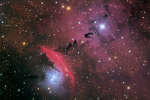
When stars form, pandemonium reigns. A textbook case is the star forming region NGC 6559. Visible above are red glowing emission nebulas of hydrogen, blue reflection nebulas of dust, dark absorption nebulas of dust, and the stars that formed from them.
 Star EGGs in the Eagle Nebula
22.10.2006
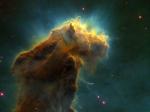
Where do stars form? One place, star forming regions known as "EGGs", are uncovered at the end of this giant pillar of gas and dust in the Eagle Nebula (M16). EGGs, short for evaporating gaseous globules, are dense regions of mostly molecular hydrogen gas that fragment and gravitationally collapse to form stars.
 IC 5146: The Cocoon Nebula
14.10.2002
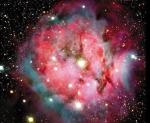
How did this nebula get created? The Cocoon Nebula, cataloged as IC 5146, is a strikingly beautiful nebula located about 4,000 light years away toward the constellation of Cygnus. Inside the Cocoon is a newly developing open cluster of stars.
 The E Nebula in Aquila
20.08.2003
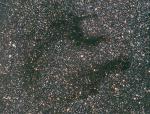
Several unusual strands of darkness are prominent toward the constellation of Aquila. This particular dark nebula is known as the E Nebula, for its evocative shape, or B142 and B143, for its position(s) on a list of such nebula compiled by Barnard.
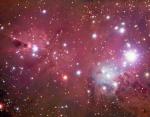 The Mysterious Cone Nebula
7.01.2002
Sometimes the simplest shapes are the hardest to explain. For example, the origin of the mysterious cone-shaped region seen on the far left remains a mystery. The interstellar formation, dubbed the Cone Nebula, is located about 2700 light years away.
|
January February March April May June July August |
||||||||||||||||||||||||||||||||||||||||||||||||||||||||