
|
You entered: solar maximum
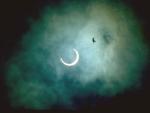 A Fleeting Eclipse
27.08.1997
A lunar eclipse can be viewed in a leisurely fashion. Visible to anyone on the night side of planet Earth (weather permitting), totality often lasts an hour or so as the moon glides through the Earth's shadow. But a solar eclipse is more fleeting.
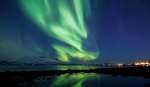 Flowing Auroras Over Norway
9.06.2013
Have you ever seen an aurora? Auroras are occurring again with increasing frequency. With the Sun peaking at its eleven year maximum in aurora-triggering activity, it is exhibiting a greater abundance of sunspots, flares, and coronal mass ejections.
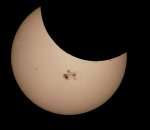 Sunspots and Solar Eclipse
25.10.2014
A New Moon joined giant sunspot group AR 2192 to dim the bright solar disk during Thursday's much anticipated partial solar eclipse. Visible from much of North America, the Moon's broad silhouette is captured in this extreme telephoto snapshot near eclipse maximum from Santa Cruz, California.
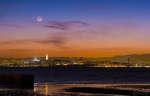 Mercury and Crescent Moon Set
14.04.2016
Innermost planet Mercury and a thin crescent Moon are never found far from the Sun in planet Earth's skies. Taken near dusk on April 8, this colorful evening skyscape shows them both setting toward the western horizon just after the Sun.
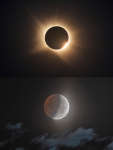 APOD: 2026 August 29 Б Eclipse Pair
28.08.2026
Eclipses tend to come in pairs. Twice a year, during an eclipse season that lasts about 34 days, Sun, Moon, and Earth can nearly align. Then the new and full phases of the Moon, separated by just over 14 days, create a solar and a lunar eclipse.
 Brisbane Sunset Moonset
1.05.2014
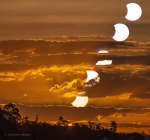
In skies over Brisbane at the southeastern corner of Queensland, Australia, Planet Earth, the Sun and New Moon set together on April 29. There the celestial line-up, the first solar eclipse of 2014, was seen as a partial solar eclipse.
 Sun 360: STEREO Captures Views of the Entire Sun
6.02.2011
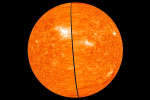
For the first time, the entire Sun is being imaged all at once. This has become possible because the two STEREO satellites orbiting and monitoring the Sun are now on opposite sides of the Sun.
 August Lunar Eclipse
8.08.2017
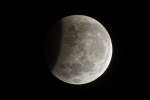
August's Full Moon is framed in this sharp, high dynamic range composition. Captured before sunrise on August 8 from Sydney, Australia, south is up and the Earth's dark, umbral shadow is at the left, near the maximum phase of a partial lunar eclipse.
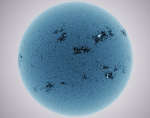 Blue Sun Bursting
20.05.2013
Our Sun is not a giant blueberry. Our Sun can be made to appear similar to the diminutive fruit, however, by imaging it in a specific color of extreme violet light called CaK that is emitted by the very slight abundance of ionized Calcium in the Sun's atmosphere, and then false color-inverting the image.
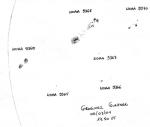 Islands in the Photosphere
14.03.2001
Awash in a sea of plasma and anchored in magnetic fields, sunspots are planet-sized, dark islands in the solar photosphere, the bright surface of the Sun. Before the enlightened(!) age of cameras, solar observers created detailed drawings of sunspots as they changed and progressed across the visible solar disk.
|
January February March April May June July August September October |
|||||||||||||||||||||||||||||||||||||||||||||||||