
|
You entered: Milky Way
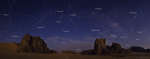 Saharan Starry Night
27.06.2009
This panoramic image of a starry night looks across a dry, desolate landscape. The magnificent view was recorded from Tassili National Park, in the heart of the Sahara desert in southern Algeria. Rising above...
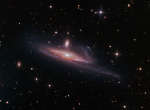 Galaxies in the River
17.07.2010
Large galaxies grow by eating small ones. Even our own galaxy practices galactic cannibalism, absorbing small galaxies that get too close and are captured by the Milky Way's gravity. In fact, the practice...
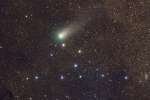 Comet Garradd and the Coat Hanger
9.09.2011
Sweeping through planet Earth's night sky, last weekend Comet Garradd (C/2009 P1) visited this lovely star field along the Milky Way in the constellation Vulpecula. Suggestively oriented, the colorful skyscape features stars in the asterism known as the Coat Hanger with the comet's tail pointing toward the southeast.
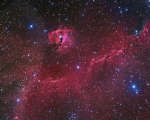 The Seagull Nebula
11.01.2014
A broad expanse of glowing gas and dust presents a bird-like visage to astronomers from planet Earth, suggesting its popular moniker - The Seagull Nebula. This portrait of the cosmic bird covers a 1.6 degree wide swath across the plane of the Milky Way, near the direction of Sirius, alpha star of the constellation Canis Major.
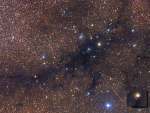 LDN 988: Dark Nebula in Cygnus
19.11.2014
Obscuring the rich starfields of northern Cygnus, dark nebula LDN 988 lies near the center of this cosmic skyscape. Composed with telescope and camera, the scene is some 2 degrees across. That corresponds to 70 light-years at the estimated 2,000 light-year distance of LDN 988.
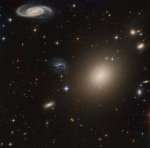 Galaxies Away
25.05.2018
This stunning group of galaxies is far, far away, about 450 million light-years from planet Earth and cataloged as galaxy cluster Abell S0740. Dominated by the cluster's large central elliptical galaxy (ESO 325-G004)...
 APOD: 2025 July 10 Б Lynds Dark Nebula 1251
10.07.2025
Stars are forming in Lynds Dark Nebula (LDN) 1251. About 1,000 light-years away and drifting above the plane of our Milky Way galaxy, LDN 1251 is also less appetizingly known as "The Rotten Fish Nebula." The dusty molecular cloud is part of a complex of dark nebulae mapped toward the Cepheus flare region.
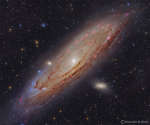 APOD: 2023 March 22 Б M31: The Andromeda Galaxy
22.03.2023
How far can you see? The most distant object easily visible to the unaided eye is M31, the great Andromeda Galaxy, over two million light-years away. Without a telescope, even this immense spiral galaxy appears as an unremarkable, faint, nebulous cloud in the constellation Andromeda.
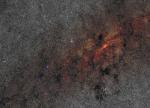 The Galactic Center in Infrared
16.07.2006
The center of our Galaxy is a busy place. In visible light, much of the Galactic Center is obscured by opaque dust. In infrared light, however, dust glows more and obscures less, allowing nearly one million stars to be recorded in the above photograph.
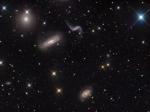 Galaxy Group Hickson 44
19.03.2007
Galaxies, like stars, frequently form groups. A group of galaxies is a system containing more than two galaxies but less than the tens or hundreds typically found in a cluster of galaxies. A most...
|
January February March April May June July August September October |
|||||||||||||||||||||||||||||||||||||||||||||||||