
|
You entered: dark cloud
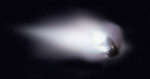 Comet Halleys Nucleus: An Orbiting Iceberg
3.01.2010
What does a comet nucleus look like? Formed from the primordial stuff of the Solar System, comet nuclei were thought to resemble very dirty icebergs. But ground-based telescopes revealed only the surrounding cloud of gas and dust of active comets nearing the Sun, clearly resolving only the comet's coma, and the characteristic cometary tails.
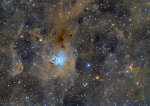 Haunting the Cepheus Flare
28.10.2021
Spooky shapes seem to haunt this dusty expanse, drifting through the night in the royal constellation Cepheus. Of course, the shapes are cosmic dust clouds visible in dimly reflected starlight. Far from your...
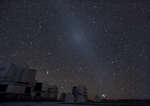 The Gegenschein Over Chile
2.12.2012
Is the night sky darkest in the direction opposite the Sun? No. In fact, a rarely discernable faint glow known as the gegenschein (German for "counter glow") can be seen 180 degrees around from the Sun in an extremely dark sky. The gegenschein is sunlight back-scattered off small interplanetary dust particles.
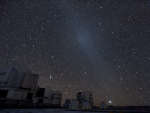 The Gegenschein Over Chile
7.05.2008
Is the night sky darkest in the direction opposite the Sun? No. In fact, a rarely discernable faint glow known as the gegenschein (German for "counter glow") can be seen 180 degrees around from the Sun in an extremely dark sky. The gegenschein is sunlight back-scattered off small interplanetary dust particles.
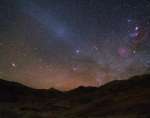 The Gegenschein Over Chile
14.01.2014
Is the night sky darkest in the direction opposite the Sun? No. In fact, a rarely discernable faint glow known as the gegenschein (German for "counter glow") can be seen 180 degrees around from the Sun in an extremely dark sky. The gegenschein is sunlight back-scattered off small interplanetary dust particles.
 APOD: 2023 October 10 Б Hidden Orion from Webb
9.10.2023
The Great Nebula in Orion has hidden stars. To the unaided eye in visible light, it appears as a small fuzzy patch in the constellation of Orion. But this image was taken by the Webb Space Telescope in a representative-color composite of red and very near infrared light.
 Big Sky Comet
21.04.1997
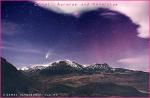
On April 17th, "Big Sky" country sure lived up to its name. The dark skies over the US states of Wyoming, Montana and the Dakotas were quite busy, as shown by this photograph featuring Comet Hale-Bopp. In the foreground is the Absaroka Mountain Range in Wyoming, lit by reflected moonlight.
 APOD: 2026 April Б Caught in the Web
2.04.2026
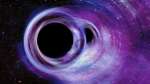
How can we see what is invisible? Black holes are not easy to see in the dark cosmic night, but astronomers can find them by analyzing their gravitational effects on matter, light and spacetime.
 Comet Holmes from the Hubble Space Telescope
27.11.2007
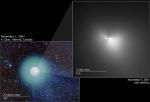
Why did Comet Holmes brighten? The unexpectedly bright Comet 17P/Holmes continues to grace northern skies as a naked-eye addition to the constellation Perseus. Any northern sky enthusiast with a dark sky, a bright curiosity, and a recent sky map should still be able to locate the comet in a few minutes.
 Descent Panorama of Saturns Titan
8.05.2006
You're the first spacecraft ever to descend to Titan -- what do you see? Immediately after the Huygen's probe pierced the cloud deck of Saturn's moon Titan last January, it took a unique series of pictures of one of the Solar System's most mysterious moon's.
|
January February March April May June July August September October |
|||||||||||||||||||||||||||||||||||||||||||||||||