
|
You entered: galaxy cluster
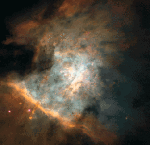 M42: Orion Nebula Mosaic
21.11.1995
The Great Nebula in Orion is one of the most interesting of all astronomical nebulae known. Here fifteen pictures from the Hubble Space Telescope have been merged to show the great expanse and diverse nature of the nebula.
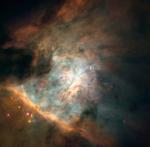 M42: A Mosaic of Orion's Great Nebula
22.05.1999
The Great Nebula in Orion, an immense, nearby starbirth region, is probably the most famous of all astronomical nebulae. Here, 15 pictures from the Hubble Space Telescope have been mosaicked to cover the inner 2.5 light years of the nebula and illustrate its diverse nature.
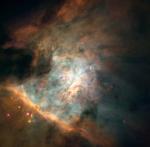 M42: A Mosaic of Orion's Great Nebula
11.05.1997
The Great Nebula in Orion, an immense, nearby starbirth region, is probably the most famous of all astronomical nebulae. Here, 15 pictures from the Hubble Space Telescope have been mosaicked to cover the inner 2.5 light years of the nebula and illustrate its diverse nature.
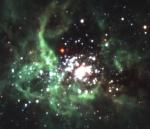 Tarantula
4.06.1997
NGC 2070 is an immense star forming region in a nearby galaxy known as the Large Magellanic Cloud. Its spidery appearance is responsible for its popular name, "The Tarantula Nebula", except that this tarantula is about 1,000 light-years across, and 165,000 light-years away in the southern constellation Dorado.
 APOD: 2025 May 27 Б Zeta and Rho Ophiuchi with Milky Way
27.05.2025
Behold one of the most photogenic regions of the night sky, captured impressively. Featured, the band of our Milky Way Galaxy runs diagonally along the bottom-left corner, while the colorful Rho Ophiuchi cloud complex is visible just right of center and the large red circular Zeta Ophiuchi Nebula appears near the top.
 A Starry Night in Brazil
9.05.2009
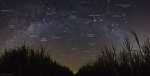
This panoramic image tracing constellations in the southern sky shows off a beautiful vista toward the center of our Milky Way Galaxy. It was recorded just last month near the city of Campos in northeastern Rio de Janeiro state, Brazil.
 The Great Carina Nebula
27.12.2018
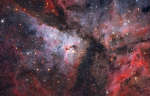
A jewel of the southern sky, the Great Carina Nebula, also known as NGC 3372, spans over 300 light-years, one of our galaxy's largest star forming regions. Like the smaller, more northerly Great...
 The Great Carina Nebula
27.05.2016
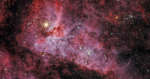
A jewel of the southern sky, the Great Carina Nebula, also known as NGC 3372, spans over 300 light-years, one of our galaxy's largest star forming regions. Like the smaller, more northerly Great...
 30 Doradus Across the Spectrum
24.12.1997
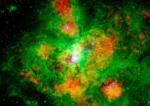
30 Doradus is lit up like a Christmas tree. Shining in light across the electromagnetic spectrum, 30 Doradus glows because of all the energetic processes that go on there. A distinctive region visible...
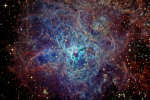 The Cosmic Web of the Tarantula Nebula
11.11.2008
First cataloged as a star, 30 Doradus is actually an immense star forming region in nearby galaxy The Large Magellanic Cloud. The region's spidery appearance is responsible for its popular name, the Tarantula nebula, except that this tarantula is about 1,000 light-years across, and 180,000 light-years away in the southern constellation Dorado.
|
January February March April May June July August September October |
|||||||||||||||||||||||||||||||||||||||||||||||||