
|
You entered: surface
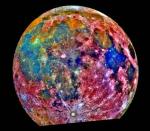 The Colorful Moon
16.03.2002
Do you recognize the Earth's Moon when you see it? The crazy, patchwork appearance of the false-color image makes this almost full view of the Moon's familiar near side look very strange.
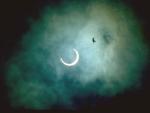 A Fleeting Eclipse
8.06.2002
A lunar eclipse can be viewed in a leisurely fashion. Visible to anyone on the night side of planet Earth (weather permitting), totality often lasts an hour or so as the moon glides through the Earth's shadow. But a solar eclipse is more fleeting.
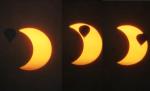 Sun, Moon, Hot Air Balloon
6.06.2003
Anticipating the celestial shadow play of a solar eclipse, sky gazers across Germany watched the Sun rise on May 31. In Bonn, astrophotographer Thilo Kranz had set up his small refractor telescope and camera on the Kennedy Bridge across the Rhein river to get a good view to the northeast.
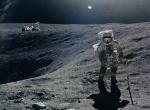 Apollo 16: Exploring Plum Crater
19.03.2000
Apollo 16 spent three days on Earth's Moon in April 1972. The fifth lunar landing mission out of six, Apollo 16 was famous for deploying and using an ultraviolet telescope as the first lunar observatory, and for collecting rocks and data on the mysterious lunar highlands. In the above picture, astronaut John W.
 A Presidential Panorama of Mars
14.05.2000
Scroll right to unfold one of the great panoramas ever taken on the surface of Mars. For best viewing, click and hold the right arrow icon at the bottom of your browser window. This image, dubbed a "presidential panorama" by the Mars Pathfinder team, shows in colorful detail the surroundings of the Sagan Memorial Station.
 Astronomer s Moon
24.08.2007
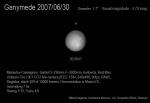
Jupiter is an astronomer's planet -- its large size and contrasting global cloud belts and zones allow detailed studies with a range of earthbound telescopes. On the other hand, most telescopic views of Jupiter's moons usually show only featureless, tantalizing points of light hovering near the ruling gas giant.
 Phobos: Moon over Mars
21.07.2017
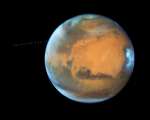
A tiny moon with a scary name, Phobos emerges from behind the Red Planet in this timelapse sequence from the Earth-orbiting Hubble Space Telescope. Over 22 minutes the 13 separate exposures were captured near the 2016 closest approach of Mars to planet Earth. Martians have to look to the west to watch Phobos rise, though.
 Sakurajima Volcano with Lightning
13.05.2018
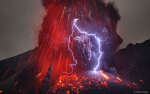
Why does a volcanic eruption sometimes create lightning? Pictured above, the Sakurajima volcano in southern Japan was caught erupting in 2013 January. Magma bubbles so hot they glowed shot away as liquid rock burst through the Earth's surface from below.
 Saturn the Giant
9.11.2019
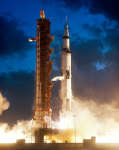
On May 25, 1961 U.S. president John Kennedy announced the goal of landing astronauts on the Moon by the end of the decade. By November 9, 1967 this Saturn V rocket was ready for launch and the first full test of its capabilities on the Apollo 4 mission.
 Into the Shadow
24.01.2020
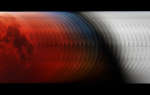
On January 21, 2019 moonwatchers on planet Earth saw a total lunar eclipse. In 35 frames this composite image follows the Moon that night as it crossed into Earth's dark umbral shadow. Taken...
|
January February March April May June July August September October |
|||||||||||||||||||||||||||||||||||||||||||||||||