
|
You entered: dust
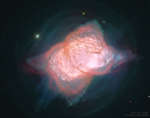 Bright Planetary Nebula NGC 7027 from Hubble
9.01.2018
It is one of the brightest planetary nebulae on the sky -- what should it be named? First discovered in 1878, nebula NGC 7027 can be seen toward the constellation of the Swan (Cygnus) with a standard backyard telescope.
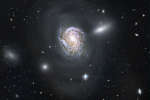 NGC 4911: Spiral Diving into a Dense Cluster
8.09.2010
Why are there faint rings around this spiral galaxy? Possibly because the galaxy, NGC 4911, is being pulled at by its neighbors as it falls into the enormous Coma Cluster of Galaxies.
 APOD: 2024 May 24 Б M78 from the Euclid Space Telescope
24.05.2024
Star formation can be messy. To help find out just how messy, ESA's new Sun-orbiting Euclid telescope recently captured the most detailed image ever of the bright star forming region M78. Near...
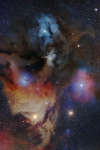 APOD: 2026 July 1 Б The Cotton Candy Clouds of Rho Ophiuchi
1.07.2026
Although they look like cotton candy, you cannot eat these clouds! Taken in Cádiz, Spain, today's image features the Rho Ophiuchi complex, a rich tapestry of young and old astronomical phenomena. This colorful cloud complex is a nearby star-forming region containing hundreds of young stellar objects, including protostars and T Tauri stars.
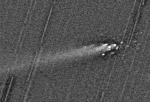 Fragments of Comet LINEAR
11.08.2000
What do you call a bunch of comet fragments anyway ... a flock, a covey, a swarm? The question is definitely relevant to comet LINEAR (C/1999 S4 LINEAR) whose nucleus apparently fragmented late last month during its first trip through the inner solar system.
 Perseid Below
10.08.2012
Denizens of planet Earth watched last year's Perseid meteor shower by looking up into the bright moonlit night sky. But this remarkable view captured on August 13, 2011 by astronaut Ron Garan looks down on a Perseid meteor.
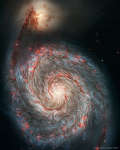 The Magnetic Field of the Whirlpool Galaxy
20.01.2021
Do magnetic fields always flow along spiral arms? Our face-on view of the Whirlpool Galaxy (M51) allows a spectacularly clear view of the spiral wave pattern in a disk-shaped galaxy. When observed with a radio telescope, the magnetic field appears to trace the arms' curvature.
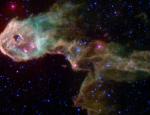 Inside The Elephant s Trunk
19.12.2003
Spectacular first images from the newly christened Spitzer Space Telescope include this penetrating interior view of an otherwise opaque dark globule known as the Elephant's Trunk Nebula. Seen in a composite of infrared...
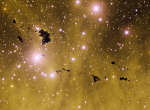 Thackerays Globules
12.06.2012
These are larger dust bunnies than you will find under your bed. Situated in rich star fields and glowing hydrogen gas, these opaque clouds of interstellar dust and gas are so large they might be able to form stars.
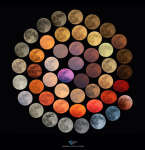 Colors of the Moon
15.05.2022
What color is the Moon? It depends on the night. Outside of the Earth's atmosphere, the dark Moon, which shines by reflected sunlight, appears a magnificently brown-tinged gray. Viewed from inside the Earth's atmosphere, though, the moon can appear quite different.
|
January February March April May June July August September October |
|||||||||||||||||||||||||||||||||||||||||||||||||