
|
You entered: Earth orbit
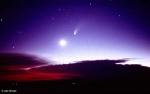 Hale-Bopp: The Crowd Pleaser Comet
9.07.1998
In 1997, the bright comet Hale-Bopp may have become the most viewed comet in history -- visible even to casual skywatchers in light polluted cities around the globe. In this picture, taken by photographer...
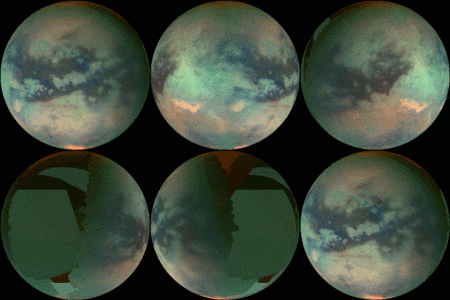 Rotating Titan in Infrared Light
15.02.2006
Titan is one of the strangest places in our Solar System. The only moon known with thick clouds, this unusual satellite of Saturn shows evidence of evaporating lakes created by methane rain. The clouds...
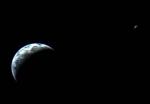 Nozomi: Earth and Moon
4.09.1998
Japan launched its first mission to orbit Mars, Nozomi (Hope), on July 3rd from the Kagoshima Space Center on the island of Kyushu. Nozomi's goal is to explore the Martian atmosphere and magnetic field as well as regions of the planet's surface and moons.
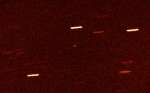 A 2017 U1: An Interstellar Visitor
3.11.2017
Traveling at high velocity along an extreme hyperbolic orbit and making a hairpin turn as it swung past the Sun, the now designated A/2017 U1 is the first known small body from interstellar space.
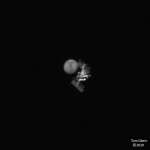 ISS Transits Mars
23.09.2020
Yes, but have you ever seen the space station do this? If you know when and where to look, watching the bright International Space Station (ISS) drift across your night sky is a fascinating sight -- but not very unusual.
 Planet Earth from Orion
18.11.2023
One year ago a Space Launch System rocket left planet Earth on November 16, 2022 at 1:47am EST carrying the Orion spacecraft on the Artemis I mission, the first integrated test of NASAБs deep space exploration systems.
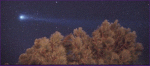 Comet Hyakutake and a Tree
10.04.1996
Comet Hyakutake is still visible as it continues its orbit around the Sun. The comet will brighten again in late April and early May. The above fascinating picture was taken with a three minute exposure. In the middle of the exposure, the photographer cleverly set off a flash, momentarily illuminating the foreground tree.
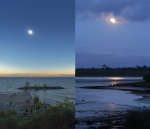 August Moons
21.08.2008
This August was eclipse season. The month's first New Moon and Full Moon were both seen in darkened skies during a solar and lunar eclipse. Blocking the Sun, the left panel...
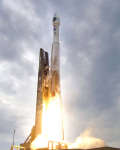 Atlas 5 Rocket Launches to the Moon
22.06.2009
This rocket is headed for the Moon. Pictured above, a huge Altas V rocket roared off the launch pad last week to start NASA's first missions to Earth's Moon in 10 years. The rocket is carrying two robotic spacecraft.
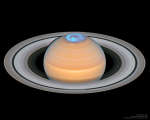 Aurora around Saturns North Pole
3.09.2018
Are Saturn's auroras like Earth's? To help answer this question, the Hubble Space Telescope and the Cassini spacecraft monitored Saturn's North Pole simultaneously during Cassini's final orbits around the gas giant in September 2017. During this time, Saturn's tilt caused its North Pole to be clearly visible from Earth.
|
January February March April May June July August September October |
|||||||||||||||||||||||||||||||||||||||||||||||||