
|
You entered: Earth's moon
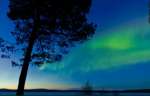 Time Lapse Auroras Over Norway
29.12.2013
Sometimes, after your eyes adapt to the dark, a spectacular sky appears. Such was the case in 2011 March when one of the largest auroral displays in recent years appeared over northern locations like the border between Norway and Russia.
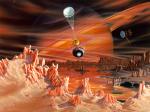 Titan Surmised
20.12.2004
What does the surface of Titan look like? Thick clouds have always made Saturn's largest moon so mysterious that seemingly farfetched hypotheses like methane rain and lakes have been seriously considered. Later this...
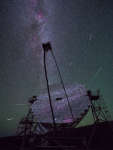 Perseids and MAGIC
11.08.2022
On August 11, 2021 a multi-mirror, 17 meter-diameter MAGIC telescope reflected this starry night sky from the Roque de los Muchachos European Northern Observatory on the Canary Island of La Palma. MAGIC stands for Major Atmospheric Gamma Imaging Cherenkov.
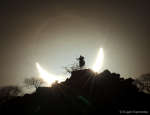 A Hybrid Solar Eclipse over Kenya
24.07.2017
Chasing solar eclipses can cause you to go to the most interesting places and meet the most interesting people. Almost. For example, chasing this eclipse brought this astrophotographer to Kenya in 2013. His contact...
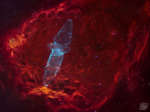 Ou4: A Giant Squid in a Flying Bat
7.10.2020
A very faint but very large squid-like nebula is visible in planet Earth's sky -- but inside a still larger bat. The Giant Squid Nebula cataloged as Ou4, and Sh2-129 also known as the Flying Bat Nebula, are both caught in this cosmic scene toward the royal royal constellation Cepheus.
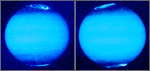 Jupiter's Auroras
18.10.1996
Auroras are especially large on Jupiter. In pictures released yesterday, the Hubble Space Telescope imaged these unusual light displays in more detail than ever before. Jupiter's auroras are linked to its volcanic moon Io.
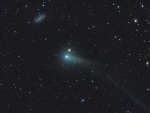 Comet PanSTARRS with Galaxy
6.06.2014
Sweeping slowly through northern skies, the comet PanSTARRS C/2012 K1 posed for this telescopic portrait on June 2nd in the constellation Ursa Major. Now in the inner solar system, the icy body from the Oort cloud sports two tails, a lighter broad dust tail and crooked ion tail extending below and right.
 APOD: 2024 April 17 Б Total Eclipse and Comets
17.04.2024
Not one, but two comets appeared near the Sun during last week's total solar eclipse. The expected comet was Comet 12P/Pons-Brooks, but it was disappointingly dimmer than many had hoped. However, relatively unknown Comet SOHO-5008 also appeared in long duration camera exposures.
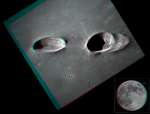 Messier Craters in Stereo
30.05.2015
Many bright nebulae and star clusters in planet Earth's sky are associated with the name of astronomer Charles Messier, from his famous 18th century catalog. His name is also given to these two large and remarkable craters on the Moon.
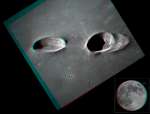 Messier Craters in Stereo
11.12.2009
Many bright nebulae and star clusters in planet Earth's sky are associated with the name of astronomer Charles Messier, from his famous 18th century catalog. His name is also given to these two large and remarkable craters on the Moon.
|
January February March April May June July August September |
|||||||||||||||||||||||||||||||||||||||||||||||||