
|
You entered: Earth orbit
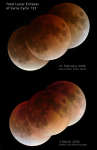 APOD: 2026 March 7 Б Two Eclipses of Saros 133
7.03.2026
Centered on maximum eclipse, these two total lunar eclipse sequences look almost identical. Yet the one shown on top is composed of images recorded in February 2008, while at the bottom is the recent March 2026 total eclipse of the Moon. Why are they so similar?
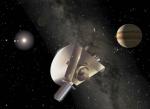 New Horizons at Jupiter
4.12.2003
Headed for the first close-up exploration of the Pluto-Charon system and the icy denizens of the Kuiper belt, NASA's New Horizons spacecraft is pictured here in an artist's vision of the robot probe outward bound.
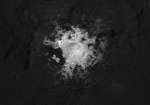 Cerealia Facula
19.07.2018
Cerealia Facula, also known as the brightest spot on Ceres, is shown in this stunning mosaic close-up view. The high-resolution image data was recorded by the Dawn spacecraft, in a looping orbit, from altitudes as low as 34 kilometers (21 miles) above the dwarf planet's surface.
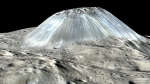 Unusual Mountain Ahuna Mons on Asteroid Ceres
16.06.2019
What created this unusual mountain? There is a new theory. Ahuna Mons is the largest mountain on the largest known asteroid in our Solar System, Ceres, which orbits our Sun in the main asteroid belt between Mars and Jupiter. Ahuna Mons, though, is like nothing that humanity has ever seen before.
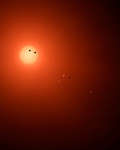 Seven Worlds for TRAPPIST 1
23.02.2017
Seven worlds orbit the ultracool dwarf star TRAPPIST-1, a mere 40 light-years away. In May 2016 astronomers using the Transiting Planets and Planetesimals Small Telescope (TRAPPIST) announced the discovery of three planets in the TRAPPIST-1 system.
 Encke and the Tadpoles
27.10.2023
History's second known periodic comet is Comet Encke (2P/Encke). As it swings through the inner Solar System, Encke's orbit takes it from an aphelion, its greatest distance from the Sun, inside the orbit of Jupiter to a perihelion just inside the orbit of Mercury.
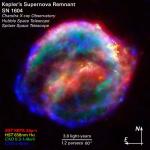 Kepler s SNR from Chandra, Hubble, Spitzer
8.10.2004
Light from the stellar explosion that created this energized cosmic cloud was first seen on planet Earth in October 1604, a mere four hundred years ago. The supernova produced a bright new star in early 17th century skies within the constellation Ophiucus.
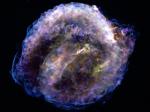 Keplers Supernova Remnant in X Rays
16.01.2007
What caused this mess? Some type of star exploded to create the unusually shaped nebula known as Kepler's supernova remnant, but which type? Light from the stellar explosion that created this energized cosmic cloud was first seen on planet Earth in October 1604, a mere four hundred years ago.
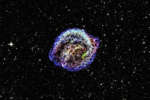 Kepler's Supernova Remnant in X Rays
15.05.2013
What caused this mess? Some type of star exploded to create the unusually shaped nebula known as Kepler's supernova remnant, but which type? Light from the stellar explosion that created this energized cosmic cloud was first seen on planet Earth in October 1604, a mere four hundred years ago.
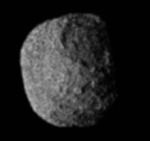 Neptune's Moon Proteus
4.11.1995
Proteus is the second largest moon of Neptune behind the mysterious Triton. Proteus was discovered only in 1982 by the Voyager 2 spacecraft. This is unusual since Neptune has a smaller moon - Nereid - which was discovered 33 years earlier from Earth.
|
January February March April May June July August September October |
|||||||||||||||||||||||||||||||||||||||||||||||||