
|
You entered: Milky Way
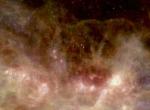 The W4 Chimney
7.02.2000
A huge chimney venting hot clouds of gas out from the plane of our Milky Way Galaxy has recently been imaged in radio waves. The Canadian Galactic Plane Survey team used an array of radio telescopes to survey an ionized gas region known as W4.
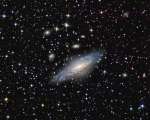 NGC 7331 and Beyond
12.07.2008
Big, beautiful spiral galaxy NGC 7331 is often touted as an analog to our own Milky Way. About 50 million light-years distant in the northern constellation Pegasus, NGC 7331 was recognized early on as a spiral nebula and is actually one of the brighter galaxies not included in Charles Messier's famous 18th century catalog.
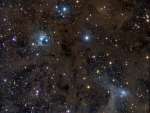 Stardust in Aries
25.11.2010
This composition in stardust covers almost 2 degrees on the sky, close to the border of the zodiacal constellation Aries and the plane of our Milky Way Galaxy. At the lower right...
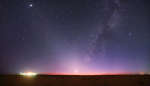 Skylights Over Libya
28.12.2010
Sometimes the sky itself seems to glow. Usually, this means you are seeing a cloud reflecting sunlight or moonlight. If the glow appears as a faint band of light running across the whole sky, you are probably seeing the combined light from the billions of stars that compose our Milky Way Galaxy.
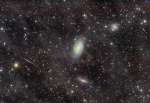 The M81 Galaxy Group Through the Integrated Flux Nebula
13.03.2012
Large galaxies and faint nebulae highlight this deep image of the M81 Group of galaxies. First and foremost in the wide-angle 12-hour exposure is the grand design spiral galaxy M81, the largest galaxy visible in the image.
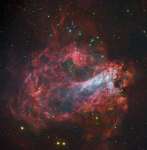 Star Factory Messier 17
18.04.2013
Sculpted by stellar winds and radiation, the star factory known as Messier 17 lies some 5,500 light-years away in the nebula-rich constellation Sagittarius. At that distance, this degree wide field of view spans almost 100 light-years.
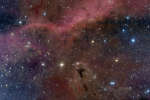 Dark Nebula LDN 1622 and Barnards Loop
6.04.2017
The silhouette of an intriguing dark nebula inhabits this cosmic scene. Lynds' Dark Nebula (LDN) 1622 appears below center against a faint background of glowing hydrogen gas only easily seen in long telescopic exposures of the region.
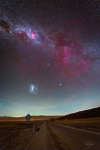 The Gum Nebula Supernova Remnant
29.11.2022
Because the Gum Nebula is the closest supernova remnant, it is actually hard to see. Spanning 40 degrees across the sky, the nebula appears so large and faint that it is easily lost in the din of a bright and complex background.
 APOD: 2024 September 8 Б M31: The Andromeda Galaxy
8.09.2024
The most distant object easily visible to the unaided eye is M31, the great Andromeda Galaxy. Even at some two and a half million light-years distant, this immense spiral galaxy -- spanning over 200,000 light years -- is visible, although as a faint, nebulous cloud in the constellation Andromeda.
 Curly Spiral Galaxy M63
22.05.2025
A bright spiral galaxy of the northern sky, Messier 63 is nearby, about 30 million light-years distant toward the loyal constellation Canes Venatici. Also cataloged as NGC 5055, the majestic island universe is nearly 100,000 light-years across, about the size of our own Milky Way.
|
January February March April May June July August September October |
|||||||||||||||||||||||||||||||||||||||||||||||||