
|
You entered: clouds
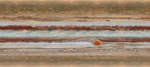 Jupiter in 2015
23.10.2015
Two remarkable global maps of Jupiter's banded cloud tops can be compared by just sliding your cursor over this sharp projection (or follow this link) of image data from the Hubble Space Telescope.
 Biomarker Phosphine Discovered in the Atmosphere of Venus
14.09.2020
Could there be life floating in the atmosphere of Venus? Although Earth's planetary neighbor has a surface considered too extreme for any known lifeform, Venus' upper atmosphere may be sufficiently mild for tiny airborne microbes. This usually disfavored prospect took an unexpected upturn yesterday with the announcement of the discovery of Venusian phosphine.
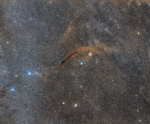 NGC 4372 and the Dark Doodad
29.03.2023
The delightful Dark Doodad Nebula drifts through southern skies, a tantalizing target for binoculars toward the small constellation Musca, The Fly. The dusty cosmic cloud is seen against rich starfields just south of the Coalsack Nebula and the Southern Cross.
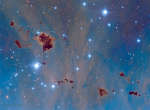 APOD: 2026 May 25 Б Thackerays Globules
24.05.2026
What are these strange space globs? Situated in rich star fields and glowing hydrogen gas, these opaque clouds of interstellar dust and gas are so large they might be able to form stars. Their...
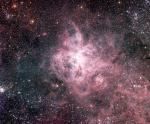 The Tarantula Zone
13.06.2002
The Tarantula Nebula is more than 1,000 light-years across - a giant emission nebula within our neighboring galaxy the Large Magellanic Cloud. Inside this cosmic arachnid lies a central young cluster of massive stars, cataloged as R136, whose intense radiation and strong winds have helped energize the nebular glow and shape the spidery filaments.
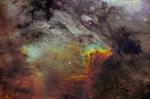 IC 5067: A Piece of the Pelican
19.10.2007
(xxxedit and linkxxx) The prominent ridge of emission featured in this dramatic skyscape is cataloged as IC 5067. Part of a larger emission nebula with a distinctive shape, popularly called The Pelican Nebula, the ridge spans about 10 light-years following the curve of the cosmic pelican's head and neck.
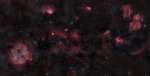 Cepheus: Trunk to Bubble
9.09.2010
Star clusters, glowing nebulae and dark dust clouds abound in Cepheus, royal constellation of the northern hemisphere. You can follow them in amazing detail across this broad skyscape, a mosaic of telescopic images spanning about 17 degrees. Beginning at the lower left, the large emission nebula is cataloged as IC 1396.
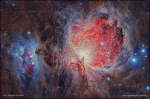 M42: The Great Orion Nebula
28.11.2017
Few astronomical sights excite the imagination like the nearby stellar nursery known as the Orion Nebula. The Nebula's glowing gas surrounds hot young stars at the edge of an immense interstellar molecular cloud.
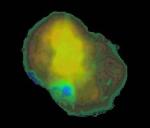 X-Rays From IC 443
2.05.1997
The life-cycles of stars help drive the ecology of our Galaxy, churning, processing, and redistributing matter. Massive stars reach a spectacular evolutionary endpoint - supernovae explosions which blast off their outer layers, violently merging stellar material with the gas and dust of the Milky Way. The supernova remnant IC 443 is typical of the aftermath.
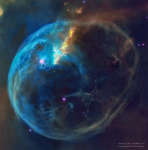 The Bubble Nebula from Hubble
22.03.2022
Massive stars can blow bubbles. The featured image shows perhaps the most famous of all star-bubbles, NGC 7635, also known simply as The Bubble Nebula. Although it looks delicate, the 7-light-year diameter bubble offers evidence of violent processes at work.
|
January February March April May June July August September October |
|||||||||||||||||||||||||||||||||||||||||||||||||