
|
You entered: constellation
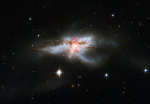 NGC 6240: Merging Galaxies
21.05.2015
NGC 6240 offers a rare, nearby glimpse of a cosmic catastrophe in its final throes. The titanic galaxy-galaxy collision takes place a mere 400 million light-years away in the constellation Ophiuchus. The merging galaxies spew distorted tidal tails of stars, gas, and dust and undergo fast and furious bursts of star formation.
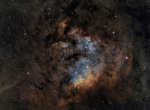 NGC 7822 in Cepheus
23.05.2015
Hot, young stars and cosmic pillars of gas and dust seem to crowd into NGC 7822. At the edge of a giant molecular cloud toward the northern constellation Cepheus, the glowing star forming region lies about 3,000 light-years away. Within the nebula, bright edges and dark shapes are highlighted in this colorful skyscape.
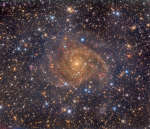 Hidden Galaxy IC 342
29.01.2016
Similar in size to large, bright spiral galaxies in our neighborhood, IC 342 is a mere 10 million light-years distant in the long-necked, northern constellation Camelopardalis. A sprawling island universe, IC 342 would otherwise...
 Orion above Easter Island
18.09.2017
Why were the statues on Easter Island built? No one is sure. What is sure is that over 800 large stone statues exist there. The Easter Island statues, stand, on the average, over twice as tall as a person and have over 200 times as much mass.
 Meteors over Inner Mongolia
13.12.2017
Did you ever get caught in a meteor shower? If yes, then every minute or so the sky sparked with fleeting flashes of light. This was the fate of the pictured astrophotographer during last year's Perseids meteor shower.
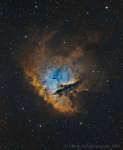 Portrait of NGC 281
22.11.2018
Look through the cosmic cloud cataloged as NGC 281 and you might miss the stars of open cluster IC 1590. Still, formed within the nebula that cluster's young, massive stars ultimately power the pervasive nebular glow.
 NGC 4676: When Mice Collide
4.10.2021
These two mighty galaxies are pulling each other apart. Known as the "Mice" because they have such long tails, each spiral galaxy has likely already passed through the other. The long tails are created by the relative difference between gravitational pulls on the near and far parts of each galaxy.
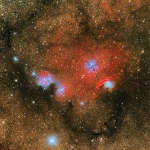 NGC 6559: East of the Lagoon
7.10.2021
Slide your telescope just east of the Lagoon Nebula to find this alluring field of view in the rich starfields of the constellation Sagittarius toward the central Milky Way. Of course the Lagoon nebula is also known as M8, the eighth object listed in Charles Messier's famous catalog of bright nebulae and star clusters.
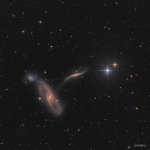 Arp 286: Trio in Virgo
10.06.2022
This colorful telescopic field of view features a trio of interacting galaxies almost 90 million light-years away, toward the constellation Virgo. On the right two spiky, foreground Milky Way stars echo the extragalactic hues, a reminder that stars in our own galaxy are like those in distant island universes.
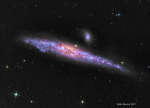 NGC 4631: The Whale Galaxy
6.10.2022
NGC 4631 is a big beautiful spiral galaxy. Seen edge-on, it lies only 25 million light-years away in the well-trained northern constellation Canes Venatici. The galaxy's slightly distorted wedge shape suggests to some a cosmic herring and to others its popular moniker, The Whale Galaxy.
|
January February March April May June July August September October |
|||||||||||||||||||||||||||||||||||||||||||||||||