
|
You entered: dust cloud
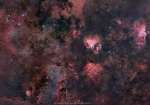 A Sagittarius Starscape
5.09.2014
This rich starscape spans nearly 7 degrees on the sky, toward the Sagittarius spiral arm and the center of our Milky Way galaxy. A telescopic mosaic, it features well-known bright nebulae and star clusters cataloged by 18th century cosmic tourist Charles Messier.
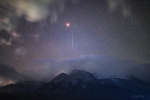 Mars and Meteor over Jade Dragon Snow Mountain
20.11.2020
A brilliant yellowish celestial beacon, Mars still dazzles in the night. Peering between clouds the wandering planet was briefly joined by the flash of a meteor in this moonless dark sky on November 18. The single exposure was taken as the Earth swept up dust from periodic comet Tempel-Tuttle during the annual Leonid Meteor Shower.
 Comet G3 ATLAS: a Tail and a Telescope
23.01.2025
Comet C/2024 G3 ATLAS has made a dramatic appearance in planet Earth's skies. A visitor from the distant Oort Cloud, the comet reached its perihelion on January 13. On January 19, the bright comet was captured here from ESO Paranal Observatory in the Atacama desert in Chile.
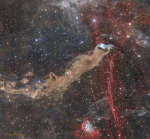 Wolfs Cave Nebula
14.11.2022
The mysterious blue reflection nebula found in catalogs as VdB 152 or Ced 201 really is very faint. It lies at the tip of the long dark nebula Barnard 175 in a dusty complex that has also been called Wolf's Cave.
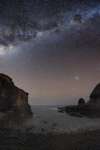 The Milky Way Over Pulpit Rock
5.07.2010
Can a picture of the sky be relaxing? A candidate for such a picture might be the above image taken only last month from Cape Schank, Victoria, Australia. The frame is highlighted by a quiet lagoon, soft ground fog, two galaxies, and tens of thousands of stars.
 Messier 10 and Comet
20.07.2022
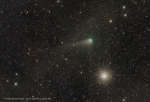
Imaged on July 15 2022, comet C/2017 K2 (PanSTARRS) had a Messier moment, sharing this wide telescopic field of view with globular star cluster Messier 10. Of course M10 was cataloged by 18th century comet hunter Charles Messier as the 10th object on his list of things that were definitely not comets.
 Dusty NGC 1333
23.11.2005
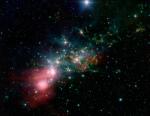
Dusty NGC 1333 is seen as a reflection nebula in visible light images, sporting bluish hues characteristic of starlight reflected by dust. But at longer infrared wavelengths, the interstellar dust itself glows - shown in red in this false-color Spitzer Space Telescope image.
 Heaven on Earth
5.11.2000
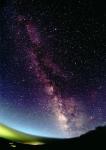
If sometimes it appears that the entire Milky Way Galaxy is raining down on your head, do not despair. It happens twice a day. As the Sun rises in the East, wonders of the night sky become less bright than the sunlight scattered by our own Earth's atmosphere, and so fade from view.
 In the Center of the Lagoon Nebula
20.08.2014
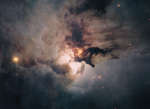
The center of the Lagoon Nebula is a whirlwind of spectacular star formation. Visible near the image center, at least two long funnel-shaped clouds, each roughly half a light-year long, have been formed by extreme stellar winds and intense energetic starlight. The tremendously bright nearby star, Hershel 36, lights the area.
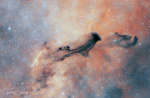 APOD: 2026 February 20 Б B93: A Dark Interstellar Ghost
19.02.2026
"A ghost in the Milky WayББ says Christian Bertincourt, the astrophotographer behind this striking image of Barnard 93 (B93). The 93rd entry in BarnardБs Catalogue of Dark Nebulae, B93 lies within the Small Sagittarius Star Cloud (Messier 24), where its darkness stands in stark contrast to bright stars and gas in the background.
|
January February March April May June July August September |
|||||||||||||||||||||||||||||||||||||||||||||||||