
|
You entered: spiral galaxy
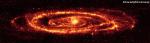 The Andromeda Galaxy in Infrared
20.10.2005
What is the Andromeda galaxy really like? To find out, astronomers looked at our largest galactic neighbor in a different light: infrared. Astronomers trained the orbiting Spitzer Space Telescope at the Messier monster (M31) for over 18 hours, creating a mosaic that incorporated 11,000 separate exposures.
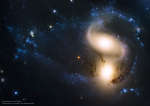 Colliding Galaxies in Stephans Quintet
10.08.2016
Will either of these galaxies survive? In what might be dubbed as a semi-final round in a galactic elimination tournament, the two spirals of NGC 7318 are colliding. The featured picture was created from images taken by the Hubble Space Telescope.
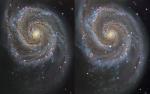 A Nearby Supernova in M51
19.07.2005
One of the nearest supernovas of recent years was discovered late last month in the bright nearby galaxy M51. It is visible on the right of the above before and after images of the picturesque spiral. Can you spot it?
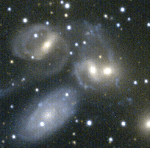 Disorder in Stephan's Quintet
10.01.1998
What are five closely grouped galaxies doing in this image? The grouping is commonly known as Stephan's Quintet. Four of the galaxies show essentially the same redshift suggesting that they are at the same distance from us.
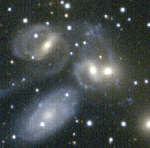 A Quintet of Galaxies
15.11.1995
Five closely grouped galaxies are visible in this image made using the Kitt Peak National Observatory 2.1 meter telescope. The grouping is commonly known as Stephan's Quintet. Four of the galaxies show essentially the same redshift suggesting that they are at the same distance from us.
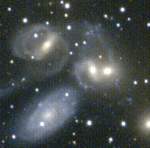 Disorder in Stephan's Quintet
13.12.1996
Five closely grouped galaxies are visible in this image made using the Kitt Peak National Observatory 2.1 meter telescope. The grouping is commonly known as Stephan's Quintet. Four of the galaxies show essentially the same redshift suggesting that they are at the same distance from us.
 Andromeda in a Single Shot
25.06.2021
How far can you see? The Andromeda Galaxy, 2.5 million light years away, is the most distant object easily seen by the unaided eye. Other denizens of the night sky, like stars, clusters, and nebulae, are typically hundreds to thousands of light-years distant.
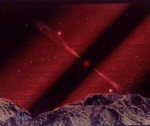 Planet Near a Galaxy Core
5.05.1996
What would the night sky look like if you lived on a planet near the center of a galaxy? Now imagine that this galaxy houses a black hole billions of times more massive than a star. From this spectacular vantage point, the sky might look like the above illustration.
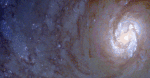 M100 and the Expanding Universe
9.01.1996
The distance to the swirling grand design spiral M100 is causing quite a stir among astronomers. Many believe that the Hubble Space Telescope's recent distance measurement to this galaxy accurately calibrates the expansion rate of the universe. Others believe this distance measurement is misleading.
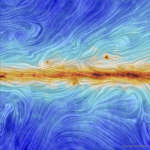 Our Galaxys Magnetic Field from Planck
26.01.2015
What does the magnetic field of our Galaxy look like? It has long been known that a modest magnetic field pervades our Milky Way Galaxy because it is seen to align small dust grains that scatter background light. Only recently, however, has the Earth-orbiting Planck satellite made a high-resolution map of this field.
|
January February March April May June July August September October |
|||||||||||||||||||||||||||||||||||||||||||||||||