
|
You entered: star
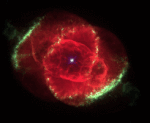 The Cat's Eye Nebula
28.06.1995
Three thousand light years away, a dying star throws off shells of glowing gas. This Hubble Space Telescope image reveals "The Cat's Eye Nebula" to be one of the most complex "planetary nebulae" known.
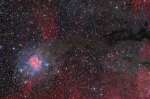 Cocoon Nebula Wide Field
13.09.2012
In this crowded starfield covering over 2 degrees within the high flying constellation Cygnus, the eye is drawn to the Cocoon Nebula. A compact star forming region, the cosmic Cocoon punctuates a long trail of obscuring interstellar dust clouds.
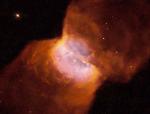 NGC 2346: A Butterfly-Shaped Planetary Nebula
28.10.2001
It may look like a butterfly, but it's bigger than our Solar System. NGC 2346 is a planetary nebula made of gas and dust that has evolved into a familiar shape. At the heart of the bipolar planetary nebula is a pair of close stars orbiting each other once every sixteen days.
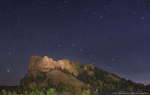 Mount Rushmore s Starry Night
4.07.2009
This starry night sky sparkles above the Black Hills of South Dakota and the United States' Mount Rushmore National Park. The historic site features enormous sculptures of four US presidents; George Washington, Thomas Jefferson, Theodore Roosevelt and Abraham Lincoln, carved into the southeast face of granite cliffs.
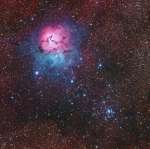 Messier 20 and 21
24.08.2018
The beautiful Trifid Nebula, also known as Messier 20, is easy to find with a small telescope in the nebula rich constellation Sagittarius. About 5,000 light-years away, the colorful study in cosmic contrasts shares this well-composed, nearly 1 degree wide field with open star cluster Messier 21 (bottom right).
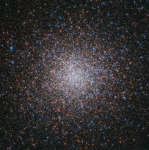 APOD: 2026 May 23 Б Messier 2
23.05.2026
After the Crab Nebula, this giant star cluster is the second entry in 18th century astronomer Charles Messier's famous list of things that are not comets. M2 is one of the largest globular star clusters now known to roam the halo of our Milky Way galaxy.
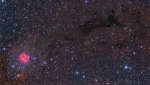 Cocoon Nebula Wide Field
18.09.2014
In this crowded starfield covering over 2 degrees within the high flying constellation Cygnus, the eye is drawn to the Cocoon Nebula. A compact star forming region, the cosmic Cocoon punctuates a long trail of obscuring interstellar dust clouds.
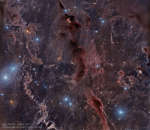 Dark Nebulas across Taurus
26.06.2018
Sometimes even the dark dust of interstellar space has a serene beauty. One such place occurs toward the constellation of Taurus. The filaments featured here can be found on the sky between the Pleiades star cluster and the California Nebula.
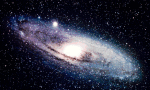 M31: The Andromeda Galaxy
1.11.1997
Andromeda is the nearest major galaxy to our own Milky Way Galaxy. Our Galaxy is thought to look much like Andromeda. Together these two galaxies dominate the Local Group of galaxies. The diffuse light from Andromeda is caused by the hundreds of billions of stars that compose it.
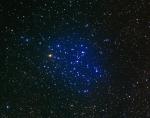 M6: The Butterfly Cluster
6.01.1999
To some, the outline of the open cluster of stars M6 resembles a butterfly. M6, also known as NGC 6405, spans about 20 light-years and lies about 2,000 light years distant.
|
January February March April May June July August September October |
|||||||||||||||||||||||||||||||||||||||||||||||||