
|
You entered: Earth orbit
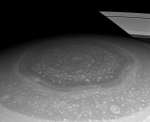 Saturns Hexagon and Rings
20.02.2013
Why would clouds form a hexagon on Saturn? Nobody is sure. Originally discovered during the Voyager flybys of Saturn in the 1980s, nobody has ever seen anything like it anywhere else in the Solar System.
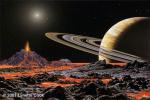 The 47 Ursae Majoris System
17.08.2001
Watching and waiting, astronomers have uncovered the presence of more than 70 planets orbiting stars other than the Sun. So far almost all these extrasolar planets have crazy elongated orbits, lie uncomfortably close to their parent stars, or are found in bizarre, inhospitable systems.
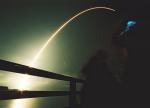 Messenger Launch
14.08.2004
Streaking into the early morning sky on August 3rd, a Delta II rocket launches NASA's Messenger spacecraft on an interplanetary voyage to Mercury. Scheduled to become the first probe to orbit Mercury, Messenger will begin by looping through the inner Solar System in a series of close flybys of planet Earth and Venus.
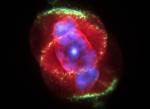 X-rays From The Cat's Eye
11.01.2001
Haunting patterns within planetary nebula NGC 6543 readily suggest its popular moniker -- the Cat's Eye nebula. In 1995, a stunning false-color optical image from the Hubble Space Telescope detailed the swirls of this glowing nebula, known to be the gaseous shroud expelled from a dying sun-like star about 3,000 light-years from Earth.
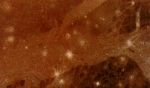 Voyager's Preview of Galileo at Ganymede
27.06.1996
NASA's robot spacecraft Galileo began its long voyage to Jupiter in October of 1989. In December of last year it arrived in the Jovian system, beginning its unprecedented, detailed exploration by dropping a probe into the gas giant's atmosphere. By early this morning it will have accomplished another milestone in its ambitious mission.
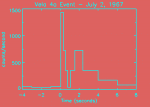 Gamma-Ray Burst: A Milestone Explosion
2.07.1997
Gamma-Ray Bursts (GRBs) were discovered by accident. In fact, GRBs always seem to be where scientists least expect them. Thirty years ago today, satellites first recorded a GRB. The burst data plotted in this histogram show that the count rate of the gamma-ray instrument abruptly jumped indicating a sudden flash of gamma-rays.
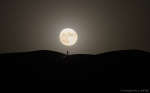 Full Moonlight
18.11.2021
A photographer in silhouette stands in bright moonlight as the Full Moon rises in this well-planned telephoto image. Of course, the Full Moon is normally the brightest lunar phase. But on November 18/19, the Full Moon's light will be dimmed during a deep partial lunar eclipse seen across much of planet Earth.
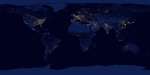 Earth at Night
7.12.2012
This remarkably complete view of Earth at night is a composite of cloud-free, nighttime images. The images were collected during April and October 2012 by the Suomi-NPP satellite from polar orbit about 824 kilometers (512 miles) above the surface using its Visible Infrared Imaging Radiometer Suite (VIIRS).
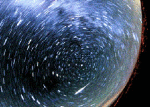 Orionids Meteor Shower to Peak Tonight
21.10.1996
Tonight you might be able to see Halley's Comet again - or at least some pieces of it. It is widely thought that that the meteors from the Orionids meteor shower, which peaks tonight, are just small pieces of Halley's Comet falling to Earth.
 APOD: 2024 July 24 Б Exaggerated Moon
24.07.2024
Our Moon doesn't really have craters this big. Earth's Moon, Luna, also doesn't naturally show this spikey texture, and its colors are more subtle. But this digital creation is based on reality.
|
January February March April May June July August September October |
|||||||||||||||||||||||||||||||||||||||||||||||||