
|
You entered: atmosphere
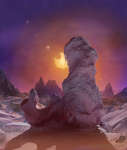 APOD: 2023 February 1 Б The Seventh World of Trappist 1
31.01.2023
Seven worlds orbit the ultracool dwarf star TRAPPIST-1. A mere 40 light-years away, many of the exoplanets were discovered in 2016 using the Transiting Planets and Planetesimals Small Telescope (TRAPPIST) located in the Atlas Mountains of Morocco, and later confirmed with telescope including NASA's Spitzer Space Telescope.
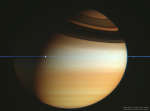 Cassini Spacecraft Crosses Saturns Ring Plane
28.12.2019
If this is Saturn, where are the rings? When Saturn's "appendages" disappeared in 1612, Galileo did not understand why. Later that century, it became understood that Saturn's unusual protrusions were rings and that when the Earth crosses the ring plane, the edge-on rings will appear to disappear.
 Passing Jupiter
25.02.2018
Here comes Jupiter! NASA's robotic spacecraft Juno is continuing on its 53-day, highly-elongated orbits around our Solar System's largest planet. The featured video is from perijove 11, the eleventh time Juno has passed near Jupiter since it arrived in mid-2016.
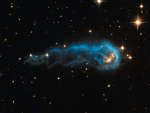 IRAS 20324: Evaporating Protostar
4.09.2013
Will this caterpillar-shaped interstellar cloud one day evolve into a butterfly-shaped nebula? No one is sure. What is sure is that IRAS 20324+4057, on the inside, is contracting to form a new star.
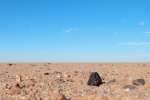 Almahata Sitta 15
27.03.2009
Small asteroid 2008 TC3 fell to Earth at dawn on October 7, 2008, tracking through the skies over the Nubian Desert in northern Sudan. That event was remarkable because it was the first time an asteroid was detected in space before crashing into planet Earth's atmosphere.
 The Great Meteor Procession of 1913
9.02.2013
One hundred years ago today the Great Meteor Procession of 1913 occurred, a sky event described by some as "magnificent" and "entrancing" and which left people feeling "spellbound" and "privileged". Because one had to be in a right location, outside, and under clear skies, only about 1,000 people noted seeing the procession.
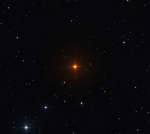 R Leporis: A Vampire's Star
30.10.2018
Better known as Hind's Crimson Star, R Leporis is a rare star in planet Earth's night sky. It's also a shocking shade of red. The star's discoverer, 19th century English...
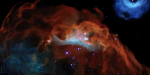 Journey into the Cosmic Reef
17.05.2020
What would you see if you could fly into the Cosmic Reef? The nebular cloud NGC 2014 appear to some like an ocean reef that resides in the sky, specifically in the LMC, the largest satellite galaxy of our Milky Way Galaxy.
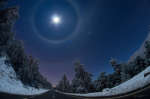 Quadruple Lunar Halo Over Winter Road
1.01.2022
Sometimes falling ice crystals make the atmosphere into a giant lens causing arcs and halos to appear around the Sun or Moon. One Saturday night in 2012 was just such a time near Madrid, Spain, where a winter sky displayed not only a bright Moon but four rare lunar halos.
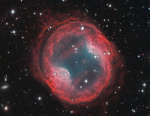 Planetary Nebula PK 164 31
30.10.2012
Is this what will become of our Sun? Quite possibly. The bubble of expanding gas pictured above is the planetary nebula PK 164 +31.1, the remnants of the atmosphere of a Sun-like star expelled as its supply of fusion-able core hydrogen became depleted.
|
January February March April May June July August September October |
|||||||||||||||||||||||||||||||||||||||||||||||||