
|
You entered: star cluster
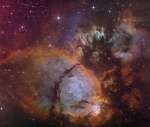 The Colors of IC 1795
10.12.2009
This colorful cosmic portrait features glowing gas and dark dust clouds in IC 1795, a star forming region in the northern constellation Cassiopeia. The nebula's colors were created by adopting the Hubble false-color...
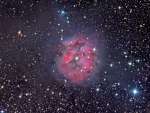 IC 5146: The Cocoon Nebula
5.03.2009
Inside the Cocoon Nebula is a newly developing cluster of stars. Cataloged as IC 5146, the beautiful nebula is nearly 15 light-years wide, located some 4,000 light years away toward the northern constellation Cygnus.
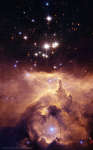 NGC 6357: Cathedral to Massive Stars
27.03.2016
How massive can a normal star be? Estimates made from distance, brightness and standard solar models had given one star in the open cluster Pismis 24 over 200 times the mass of our Sun, making it one of the most massive stars known.
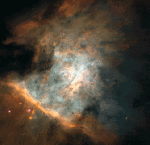 M42: Orion Nebula Mosaic
21.11.1995
The Great Nebula in Orion is one of the most interesting of all astronomical nebulae known. Here fifteen pictures from the Hubble Space Telescope have been merged to show the great expanse and diverse nature of the nebula.
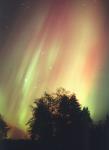 October Skylights
8.11.2000
With brilliant Venus above the western horizon at sunset and Jupiter and Saturn high in the east by early evening, November's night sky is filled with bright planets. October's sky featured bright planets as well and, triggered by the active Sun, some lovely auroral displays.
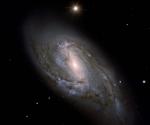 Dusty Spiral M66
2.09.2006
When morning twilight came to the Paranal Observatory in Chile, astronomers Mark Neeser and Peter Barthel interrupted their search for faint quasars, billions of light-years away. And just for a moment, they used Very Large Telescopes at the European Southern Observatory to appreciate the beauty of the nearby Universe.
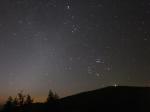 Mysterious Streaks Over Turkey
15.08.2007
What are they? Five streaks near the bottom of the above image taken near Ankara, Turkey on Sunday would be identified at first glance as meteors from the Perseids meteor shower peaking just that night. Unexpectedly, however, these streaks do not point back to the Perseids radiant in Perseus. Their origin is therefore somewhat unclear.
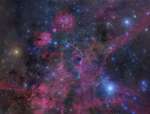 Vela Supernova Remnant
6.03.2008
The plane of our Milky Way Galaxy runs through this complex and beautiful skyscape. At the northwestern edge of the constellation Vela (the Sails) the 16 degree wide, 30 frame mosaic is centered on the glowing filaments of the Vela Supernova Remnant, the expanding debris cloud from the death explosion of a massive star.
 APOD: 2023 December 10 Б Big Dipper over Pyramid Mountain
10.12.2023
When did you first learn to identify this group of stars? Although they are familiar to many people around the world, different cultures have associated this asterism with different icons and folklore. Known...
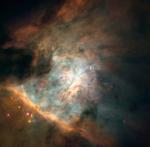 M42: A Mosaic of Orion's Great Nebula
22.05.1999
The Great Nebula in Orion, an immense, nearby starbirth region, is probably the most famous of all astronomical nebulae. Here, 15 pictures from the Hubble Space Telescope have been mosaicked to cover the inner 2.5 light years of the nebula and illustrate its diverse nature.
|
January February March April May June July August September October |
|||||||||||||||||||||||||||||||||||||||||||||||||