
|
You entered: Deep Sky
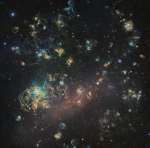 Clouds of the Large Magellanic Cloud
3.05.2019
The Large Magellanic Cloud (LMC) is an alluring sight in southern skies. But this deep and detailed telescopic view, over 10 months in the making, goes beyond what is visible to most circumnavigators of planet Earth.
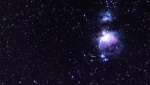 Geostationary Highway through Orion
16.01.2017
Put a satellite in a circular orbit about 42,000 kilometers from the center of the Earth and it will orbit once in 24 hours. Because that matches Earth's rotation period, it is known as a geosynchronous orbit.
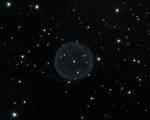 Spherical Planetary Nebula Abell 39
28.07.2005
Ghostly in appearance, Abell 39 is a remarkably simple, spherical nebula about five light-years across. Well within our own Milky Way galaxy, the cosmic sphere is roughly 7,000 light-years distant toward the constellation Hercules.
 Fireball Over Edmonton
25.11.2008
What if you're driving down the street and an object from space shoots across the sky right in front of you? Such was the case last week for many people in south central Canada.
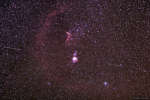 Geostationary Highway
20.02.2010
Put a satellite in a circular orbit about 42,000 kilometers from the center of the Earth (36,000 kilometers or so above the surface) and it will orbit once in 24 hours. Because that matches Earth's rotation period, it is known as a geosynchronous orbit.
 The Moon During a Total Lunar Eclipse
25.05.2021
How does the Moon's appearance change during a total lunar eclipse? The featured time-lapse video was digitally processed to keep the Moon bright and centered during the 5-hour eclipse of 2018 January 31. At first the full moon is visible because only a full moon can undergo a lunar eclipse.
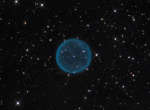 Spherical Planetary Nebula Abell 39
8.10.2012
Ghostly in appearance, Abell 39 is a remarkably simple, spherical nebula about five light-years across. Well within our own Milky Way galaxy, the cosmic sphere is roughly 7,000 light-years distant toward the constellation Hercules.
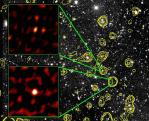 Distant Galaxies in Radio Vision
8.02.2001
Radio waves, like visible light, are electromagnetic radiation and radio telescopes can "see" -- their signals translated into radio images of the cosmos. While individually even the largest radio telescopes have very blurry vision compared to their optical counterparts, networks of radio telescopes can combine signals to produce sharper pictures.
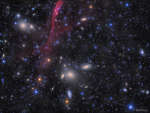 The Antlia Cluster of Galaxies
18.10.2016
Galaxies dot the sky in this impressively wide and deep image of the Antlia Cluster. The third closest cluster of galaxies to Earth after Virgo and Fornax, the Antlia cluster is known for its compactness and its high fraction of elliptical galaxies over (spirals.
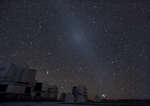 The Gegenschein Over Chile
2.12.2012
Is the night sky darkest in the direction opposite the Sun? No. In fact, a rarely discernable faint glow known as the gegenschein (German for "counter glow") can be seen 180 degrees around from the Sun in an extremely dark sky. The gegenschein is sunlight back-scattered off small interplanetary dust particles.
|
January February March April May June July August September |
|||||||||||||||||||||||||||||||||||||||||||||||||